How to Choose the Right Battery Tender or Maintainer
To learn how to choose the correct battery tender, match voltage and chemistry first, then check the battery's allowed charging current. Choose automatic maintenance for storage and suitable charging capacity for regular recharging.
On this page (10 sections)
- How to choose the correct battery tender before you buy
- Do you need maintenance, recharging or recovery?
- Which voltage and chemistry must the charger support?
- How much charging current should you choose?
- Which of these four models fits your use?
- Which connections and cable lengths fit your parking space?
- How should you set up a battery tender for the first time?
- How do you choose the correct battery tender for storage?
- Which common mistakes should you avoid?
- Which battery tender should you choose?
To learn how to choose the correct battery tender, match your battery's voltage and chemistry first, then choose a charging current your battery allows. After that, compare maintenance modes, connections and features that fit how you use the vehicle.
Start with the battery label and manual, rather than the vehicle's size. A motorcycle, car or boat can use different battery types, and the right charger must suit the battery actually installed.
If you're comparing equipment across vehicles, see our guide to battery maintainers and chargers for cars, trucks and boats.
How to choose the correct battery tender before you buy
Check voltage, chemistry and allowed charging current before comparing convenience features. A charger that fails any of these checks belongs off your shortlist.
Write down the battery's model number and capacity in amp-hours, often shown as Ah. If you only find cold cranking amps, or CCA, don't treat that number as battery capacity.
| Check | What you need to confirm |
|---|---|
| Voltage | The charger supports the battery's nominal voltage |
| Chemistry | A charging mode covers the exact battery type |
| Capacity | The battery falls within the charger's supported range |
| Current | The output stays within the battery's charging limits |
| Purpose | The charger suits storage, recharging or both |
| Setup | Cables, connections and placement fit your parking space |
Cold cranking amps describe starting ability, while amp-hours describe stored charge. Those numbers answer different questions, so neither replaces the battery maker's charging guidance.
For multiple batteries, make a separate note for each one. Similar cases or matching terminal layouts don't prove that the batteries need the same charging mode.
Do you need maintenance, recharging or recovery?
Choose maintenance for a charged battery in storage, routine charging for a depleted battery, and recovery features only when low voltage is part of the problem. These jobs place different demands on a charger.
A stored vehicle slowly loses charge through battery self-discharge and any electrical loads that remain active. A compatible automatic maintainer replaces that loss while managing the charge level.
A battery depleted by short trips or an accessory needs charge put back before maintenance begins. A charger-maintainer can handle both jobs, but a low output may take longer than your schedule allows.
Deep discharge is a separate concern because some chargers won't begin charging below their detection threshold. A special mode can address that starting barrier without proving that the battery is still usable.
Repeated discharge also deserves attention to the vehicle and battery. Loose connections, an unwanted electrical drain or a worn battery won't be solved by choosing a larger charger.
Read what a battery maintainer is and how it differs from a battery charger if you're deciding which job matters most.
Which voltage and chemistry must the charger support?
Choose a charger with an approved mode for both the battery voltage and chemistry. Support for each somewhere in the manual doesn't mean every possible combination is allowed.
A switchable charger may cover several battery types through separate settings. Confirm the exact mode needed for your battery instead of assuming that one selection handles everything automatically.
Check the battery voltage first
Use the nominal voltage on the battery label, not a low reading from a discharged battery. A depleted 12V battery doesn't become a 6V battery because its measured voltage has fallen.
Also check how batteries are connected in boats, RVs and other equipment. Two batteries can form a system whose total voltage differs from the voltage of either battery alone.
Don't attach a charger across a battery bank unless its instructions cover that arrangement. Charging one battery within a connected bank may also require steps from the equipment manual.
Match the charging mode to the chemistry
Flooded lead-acid, AGM and gel batteries can need different charging limits. A sealed battery isn't automatically AGM, so use the label or model documentation to identify it.
For lithium, look for the exact chemistry, such as LiFePO4. Don't assume a charger marked for lithium suits every lithium battery or can override restrictions from its battery management system.
If you have AGM, our guide to charging an AGM battery with a regular charger explains why the charging profile matters.
How much charging current should you choose?
Choose current within the battery's allowed range, then consider how long you can wait for charging. More output helps only when the battery can accept it.
A small powersports battery may have a much lower recommended charge current than a vehicle starting battery. Check this before using a charger bought for your car on a smaller battery.
For storage, output must be sufficient to cover self-discharge and any ongoing load. If the vehicle consumes more than the charger can replace, the battery can still lose charge while connected.
How to choose the correct battery tender by amps
Compare the battery's recommended charging current with the charger's output and supported capacity range. Then choose enough charging ability for your usual task without exceeding those limits.
As a rough planning example, replacing 20 Ah at a steady 4A would take 5 hours before allowing for charging losses and the slower finishing stage. Real charging takes longer because current doesn't stay at its maximum throughout.
That calculation helps compare waiting time, but it isn't a completion promise. Battery condition, temperature, starting charge and the charging profile all affect the result.
If you need the vehicle ready in a few hours after a large discharge, a storage-focused choice may be too slow. Our guide to how long it takes to charge a car battery covers the timing factors.
Which of these four models fits your use?
Choose the model whose supported modes and charging features solve your actual task. The differences below matter more than choosing solely by brand or the highest amp number.
| Model | Output and voltage | Best reason to consider it |
|---|---|---|
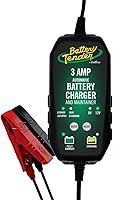
| Battery Tender 3A | 3A; selectable 6V or 12V | Routine upkeep of compatible lead-acid batteries |
| Battery Tender 4A | 4A; selectable 6V or 12V | Moving between supported lead-acid and LiFePO4 batteries |
| Battery Tender 5A 12V | 5A; 12V | Recharging and maintaining compatible 12V batteries |
| NOCO Genius5 | 5A; 6V or 12V | Temperature adjustment and low-voltage charging features |
Battery Tender 3A: for routine lead-acid upkeep
Choose Battery Tender 3A when your main job is keeping compatible flooded, AGM or gel batteries ready between uses. Its selectable voltage suits a garage with different battery voltages, provided each battery allows its output.
It charges before moving into automatic float maintenance, and a two-color LED shows charging status. Battery Tender's adaptive charging resumes full output when battery voltage falls sufficiently under load.
Skip it if your main need is frequent recharging where a compatible higher-current charger would save useful time. Also skip it for a small battery whose allowed charge current is below this model's output.
Lithium compatibility is named for this model, but confirm the precise lithium chemistry and supported voltage mode in its manual. For a lithium-focused choice, the other options here explicitly identify LiFePO4 support.
Battery Tender 4A: for a mixed garage
Choose Battery Tender 4A if you want one charger to move among supported lead-acid and LiFePO4 batteries. Its combination of voltage selection and chemistry support makes it a practical fit for varied equipment.
It switches to float maintenance after charging and uses adaptive monitoring to resume charging as needed. Check the required mode whenever you move it to another battery, even if the connector fits without changes.
Skip it if any battery you plan to charge requires less current or a mode this charger doesn't offer. Choose based on the batteries you have now, rather than possible future equipment alone.
This model has one charging port. Moving it between batteries is different from maintaining several batteries independently at the same time.
Battery Tender 5A 12V: for a dedicated 12V setup
Choose Battery Tender 5A 12V when all intended batteries are compatible 12V models and you want charging as well as storage maintenance. It supports flooded lead-acid, AGM, gel and LiFePO4 batteries.
Its four charging stages are qualification, bulk, absorption and float. That sequence checks the battery, supplies charge, completes charging and then maintains it.
A 72-hour timer is included to limit charging on marginal batteries. It isn't a promise that charging takes that long or that a battery showing a fault should be repeatedly restarted.
Skip this model if you need to charge 6V batteries. It's also unnecessary to choose extra current solely for maintaining an already charged battery when a lower-output compatible model meets your needs.
NOCO Genius5: for changing temperatures and low-voltage needs
Choose NOCO Genius5 if temperature adjustment or low-voltage charging is a reason for buying. It supports lead-acid types and LiFePO4 batteries, with a stated battery capacity range up to 120 Ah.
Its thermal sensor adjusts charging based on ambient temperature. Place the charger as instructed so it can sense conditions around the battery rather than an unrelated heat source.
Normal charging can begin from 1V, and Force Mode allows manual charging down to zero volts. Use that mode only after confirming battery type, polarity and condition through the manual's checks.
NOCO describes pulse charging intended to address sulfation and acid stratification in lead-acid batteries. Don't buy it expecting those functions to restore every old battery or repair internal damage.
Skip it if you only need straightforward maintenance and won't use its added features. You can read our NOCO Genius5 review for a closer look at its controls and uses.
Which connections and cable lengths fit your parking space?
Choose secure connections with enough cable reach to keep the charger safely placed. Measure the route around the vehicle before buying, including any distance needed to avoid pinch points.
All 3 Battery Tender models include ring terminal and alligator clip combination cables. Each offers 11 ft of combined reach, split between a 6 ft AC cord and a 5 ft DC charging cord.
Combined reach doesn't mean you can position the charger anywhere along that distance. Both sides must reach their own connection points while leaving the charger in a suitable location.
NOCO Genius5 includes clamps with integrated eyelet terminals, a 72 in AC cable and an 80 in DC cable. It also includes a mounting bracket and screws for a suitable installation.
Clamps suit occasional charging and moving between batteries. Ring terminals can simplify repeated connections to a hard-to-reach battery when installed and protected according to the manual.
Keep leads away from belts, fans, exhaust parts and sharp edges. Don't close a hood or seat onto a cable unless the route leaves it clear of pressure and moving parts.
How should you set up a battery tender for the first time?
Begin with a sound battery, the correct mode and a secure connection. Inspect everything before supplying power, even if the charger includes protective features.
- Identify the battery voltage, chemistry and charging limits.
- Check for damage, swelling, leaks or signs of freezing.
- Read the vehicle's charging instructions and locate any designated charging points.
- Place the charger in a dry, ventilated position allowed by its manual.
- With AC power disconnected, attach the leads in the required sequence.
- Select or confirm the charging mode as instructed.
- Connect power, check the status indicator and watch for faults.
Some vehicles require designated charging points so their battery monitoring system can account for charging. Follow the vehicle manual rather than assuming direct connection to both battery terminals is always preferred.
The Battery Tender models here include spark-proof lead connection and reverse-polarity detection. Those protections support correct setup; they don't replace checking the terminals and following the connection sequence.
For more detail, follow how to hook up a battery tender and our guide to using a battery tender.
How do you choose the correct battery tender for storage?
For storage, choose automatic maintenance approved for your battery and connection period. Charger placement and regular checks matter as much as the maintenance label.
The Battery Tender models move into float operation after charging. NOCO Genius5 monitors the battery during maintenance, and NOCO permits extended connection under its instructions.
Fully charge the battery before a long storage period when possible. Record the expected indicator state so a later fault or loss of outlet power is easier to notice.
Check cables for wear, connections for corrosion and the battery for changes in condition. For serviceable flooded batteries, follow the battery maker's electrolyte inspection guidance without opening sealed batteries.
Don't assume a charger suitable for a boat battery is suitable for exposed outdoor mounting. Use it only in the conditions allowed by its manual, with electrical connections protected as required.
Our guide to leaving a battery tender on all the time covers ongoing checks. For seasonal parking, see how to winterize a car for storage.
Which common mistakes should you avoid?
Avoid wrong modes, unsuitable current and unattended fault conditions. These mistakes can turn a compatible charger into a poor setup.
- Choosing by vehicle size: A truck label doesn't identify chemistry or charging limits.
- Confusing LiFePO4 with all lithium batteries: Match the exact battery chemistry.
- Using recovery as routine maintenance: Special modes have specific instructions and limits.
- Expecting a maintainer to start an engine: Charging and jump-starting are different jobs.
- Ignoring repeated faults: Check connections and battery condition before restarting.
- Leaving accessories running: Ongoing loads can prevent charging from finishing.
- Connecting multiple batteries casually: One charging port doesn't provide separate control for each battery.
Don't rely on a fixed charge-time number without considering capacity and starting charge. A battery that repeatedly fails to finish charging needs attention, rather than an endless series of restarts.
Also check the mode after reconnecting power or changing batteries. Follow the charger's instructions for how settings are selected and retained.
Which battery tender should you choose?
Knowing how to choose the correct battery tender comes down to ruling out incompatible models first, then buying for your usual job. Use the battery's requirements to settle the choice.
Choose Battery Tender 3A for compatible lead-acid upkeep when its current meets your needs. Choose Battery Tender 4A for moving among supported battery types in a mixed garage.
Choose Battery Tender 5A 12V for a dedicated compatible 12V setup. Choose NOCO Genius5 when temperature adjustment or low-voltage charging features address a need you actually have.
For more choices, compare our best battery tender guide, or use NOCO Genius vs Battery Tender to compare the brands.
Before ordering, write down the required voltage, chemistry mode, allowed current and cable route. If current is the remaining question, use our guide to what size battery charger you need for the next sizing step.
Frequently asked questions
How do I choose the correct battery tender?
Match the charger's voltage and charging mode to your battery first, then check its allowed charging current; decide whether you need storage maintenance or regular recharging, and choose connections that suit your parking space. Before buying, confirm the charger manual covers your battery's chemistry, capacity and intended use.
What amp battery tender do I need?
Choose an output within the battery maker's charging limits and the charger's supported capacity range; storage maintenance usually needs less current than recharging a depleted battery. A higher output can reduce charging time, but small batteries may need lower current, and the final charging stage still takes time.
Can one battery tender charge AGM and lithium batteries?
Yes, some chargers support both AGM and LiFePO4 batteries through suitable charging modes; check the exact chemistry and voltage combination in the charger manual before connecting. Lithium support doesn't cover every lithium battery, and a mode intended for lead-acid repair should never be assumed suitable for lithium.
Can I leave a battery maintainer connected?
Yes, if the charger and battery instructions allow extended maintenance with your chosen mode; inspect the battery, cables and connections regularly, and follow placement and ventilation guidance. Automatic maintenance still needs a sound setup; our guide to leaving a battery tender connected explains the storage checks.
Will a battery tender charge a dead battery?
Some charger-maintainers can recharge a discharged battery, but a very low voltage may prevent normal charging from starting; recovery features vary, and no mode repairs physical damage. Read whether a battery tender can charge a dead battery before choosing equipment for a deeply discharged battery.