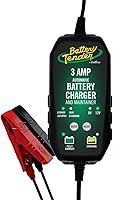
Battery Maintainer vs Battery Charger: Which Is Better? (October 2026)
The battery maintainer vs battery charger choice depends on the job: recharge a low battery with a charger, or keep a charged battery ready with a maintainer. A compatible combination unit can do both.
On this page (10 sections)
- Battery maintainer vs battery charger: what is the difference?
- What does a battery maintainer do during storage?
- When do you need a battery charger instead?
- Which combination charger suits your battery and routine?
- Does a higher amp charger work better?
- Can you maintain AGM and lithium batteries the same way?
- How should you connect a charger or maintainer?
- Can you leave either device connected for months?
- Which charging mistakes should you avoid?
- Battery maintainer vs battery charger: which is right for you?
The battery maintainer vs battery charger decision comes down to your starting point: a charger replenishes a low battery, while a maintainer keeps a charged battery ready during storage. Many smart units combine both jobs.
Choose by battery compatibility and intended use before comparing amps. A high-output charger can help with recharging, but a storage setup needs a device that manages a full battery and permits extended connection.


Battery maintainer vs battery charger: what is the difference?
A charger replaces lost energy, while a maintainer manages charge over time. The difference is what happens as the battery fills, rather than simply how much current the device can deliver.
During charging, a suitable smart charger controls its output through several stages. Current usually falls toward the end, so a higher maximum output does not shorten every part of the process equally.
A maintainer responds to the battery's needs after it reaches the target charge. Depending on its design, it may hold a controlled maintenance voltage or pause and resume charging.
That makes a maintainer useful for a parked vehicle whose battery slowly loses charge through self-discharge and small electrical loads. It does not repair a worn-out battery or solve an excessive electrical drain.
Battery maintainer vs charger: match the job first
Start with battery condition and your available time. A healthy, charged battery going into storage needs different care from a low battery you need to recharge before tomorrow's drive.
| Your situation | What to choose | What matters most |
|---|---|---|
| Charged battery in a seasonal vehicle | Maintainer or combination unit | Approved extended maintenance |
| Low battery after lights were left on | Charger or combination unit | Suitable charging rate and mode |
| Several batteries with different needs | Adjustable charger-maintainer | Chemistry support and rate selection |
| Battery repeatedly goes flat | Diagnosis before another device | Battery condition and vehicle drain |
| Vehicle needs to start immediately | Appropriate starting assistance | A charger is not automatically a jump starter |
Buying a combination unit can avoid needing separate tools. There is little benefit in replacing a compatible charger-maintainer you already have just because another device uses a different name.
What does a battery maintainer do during storage?
A maintainer offsets gradual charge loss so a healthy battery stays ready while the vehicle sits. It suits seasonal cars, motorcycles, lawn equipment and other vehicles used only occasionally.
Read our guide to what a battery maintainer does if you need help understanding maintenance modes. Low current alone does not make a device suitable for unattended storage.
Start storage with a charged battery. A small maintenance-focused device may recharge some batteries, but restoring a large charge deficit can take much longer than keeping up with normal losses.
Check that the storage location has a suitable outlet and allows you to route cables safely. A cord stretched across a walkway or pinched under a hood creates a problem that automatic charging cannot prevent.
Skip a maintainer as your first solution if a regularly driven vehicle keeps failing to start. A weak battery, loose connection, charging-system fault or unusual electrical drain needs attention.
For the routine itself, our guide to using a battery tender explains connection and ongoing care. Make those checks part of storage preparation rather than waiting until the vehicle will not start.
When do you need a battery charger instead?
Choose a charger when the battery needs energy restored, especially when a maintenance-only device would take too long. Match its output to the battery's charging limits.
A battery can be low after an interior light stays on, repeated short trips or an extended period parked. Charging can restore lost energy, but it will not correct the cause if the problem keeps returning.
Do not assume a short drive will fully recharge a deeply discharged battery. Use a suitable charging process and investigate repeated discharge before relying on the vehicle again.
A charger also needs time and access to AC power. None of the charging functions discussed here should be treated as an engine-start or jump-start function.
Skip charging and seek help if the battery is frozen, leaking, swollen or visibly damaged. Unusual heat, smoke or a strong odor during charging also calls for stopping the process safely.
Which combination charger suits your battery and routine?
Choose the NOCO for storage-led use, Schumacher for occasional car recharging, or Clore for selectable charging rates. All three combine charging and maintenance, but their battery support and extra functions differ.
The useful distinction is how you expect to use the device most often. Extra output matters when your battery accepts it and you need to recharge regularly; it adds less value when upkeep is the main job.
NOCO Genius5 for seasonal vehicle storage
The NOCO Genius5 pairs 5A charging with automatic maintenance for compatible 6V and 12V lead-acid batteries and LiFePO4 batteries in the appropriate mode. Its thermal sensor adjusts charging based on ambient temperature.
It suits a household that stores a vehicle but also needs occasional recharging. Included clamps and integrated eyelet terminals offer connection options, subject to the vehicle's approved connection method.
Choose it when broad chemistry support and ongoing upkeep matter more than maximum charging speed. Skip it if your main task is quickly replenishing larger batteries that permit substantially higher current.
Our NOCO Genius5 review covers its role in more detail. Confirm the exact voltage and chemistry combination before selecting a mode, especially for lithium batteries.
Schumacher SC1280 for occasional car recharging
The Schumacher SC1280 provides 15A charging for compatible 12V batteries and a separate 2A charging mode for 6V batteries. It supports standard, AGM, gel and deep-cycle lead-acid batteries, with automatic voltage detection and maintenance.
This is a sensible fit when a compatible car battery needs recharging more often than a seasonal vehicle needs storage care. Automatic detection helps with operation, but you still need to confirm the battery type and permitted charging current.
Skip it if you need LiFePO4 charging or if your battery requires a lower charging rate than the selected mode allows. Desulfation is an extra function, not a reason to keep a battery that no longer holds charge.
Clore PL2320 for varied garage tasks
The Clore PL2320 offers 2, 10 and 20A charge rates for compatible 6V and 12V lead-acid batteries. Supported types include flooded, AGM, gel and spiral-wound batteries, including compatible marine and deep-cycle batteries.
Its selectable rates suit a garage where different batteries call for different charging currents. Choose the rate from the battery maker's guidance rather than using the highest setting by default.
The separate stable power supply mode is useful only when a service procedure calls for that function and the equipment meets the procedure's requirements. It is not a substitute for selecting the right charging or maintenance mode.
Skip this model if you need lithium support or only want straightforward upkeep for one stored vehicle. Those needs do not call for its broader choice of charging rates.
Does a higher amp charger work better?
Higher current can shorten recharging when the battery accepts it, but it does not make maintenance better. Capacity, charge level, temperature and the charging profile all affect the result.
Check the battery maker's recommended current before choosing charger output. A rate suitable for a large vehicle battery may be too high for a small powersport battery.
For a rough planning example, a 60Ah battery at half charge is missing about 30Ah. At a constant 5A, replacing that amount would take 6 hours before allowing for losses and the slower final charging stage.
That calculation is a starting point, not a completion time. Do not stop charging solely because the estimated hours have passed; follow the charger's completion indication and instructions.
Use our guide to what size battery charger you need to match output to the battery. For scheduling a recharge, see how long charging a car battery takes.
Can you maintain AGM and lithium batteries the same way?
Use the mode intended for the exact battery chemistry. Matching voltage is necessary, but batteries with the same nominal voltage can need different charging behavior.
AGM is a lead-acid design, while LiFePO4 is a specific lithium chemistry. A mode intended for one should not be used for the other unless the battery and charger instructions explicitly permit it.
“Deep-cycle” describes a battery's intended use rather than identifying its chemistry by itself. Likewise, “marine” does not tell you which charging profile to select.
For AGM batteries, read whether you can charge an AGM battery with a regular charger. For lithium, check the battery's temperature limits as well as its voltage and charging-current limits.
A charger's ambient temperature sensor does not cancel the battery maker's restrictions. If charging is prohibited at the battery's current temperature, wait for suitable conditions.
How should you connect a charger or maintainer?
Follow the vehicle, battery and charger instructions together, using approved connection points and the correct mode. Some vehicles use designated terminals so their battery-management system can account for charging.
- Identify the battery. Read its voltage, chemistry and charging guidance, then check for damage before connecting anything.
- Prepare the area. Turn off the vehicle and accessories, allow ventilation, and keep flames and sparks away.
- Position the equipment. Keep the charger on a stable surface as directed, with leads clear of fans, belts, exhaust parts and sharp edges.
- Connect with AC power disconnected. Follow the specified clamp sequence and connection points, then select the required mode.
- Check operation. Confirm the charger recognizes the battery and shows normal charging or maintenance rather than an error.
- Disconnect as instructed. Remove AC power before removing battery connections, following the manual's sequence.
For a closer explanation of attachment points and cable routing, use our guide to hooking up a battery tender.
If you use eyelet leads for repeated connections, secure them away from moving parts and protect the unused connector as directed. Inspect the cable before each use rather than assuming a permanent attachment remains sound.
Can you leave either device connected for months?
Use extended connection only when the charger and battery instructions allow it. Automatic maintenance supports storage care, but the setup still needs periodic inspection.
Check for damaged insulation, loose connections, moisture and blocked ventilation. Follow any battery-specific care requirements, including electrolyte checks only on batteries designed for that service.
Do not assume a garage charger can sit outdoors or under a cover exposed to rain. Place it within its stated environmental limits and avoid routing an unsuitable extension cord through wet areas.
Our guide to leaving a battery tender connected covers longer connections. For the wider storage routine, see how to winterize a car's battery.
Which charging mistakes should you avoid?
Avoid wrong modes, excessive current and repeated recovery attempts on a failing battery. Most preventable problems start with treating every battery as if it needs the same care.
- Choosing by vehicle type alone: Two cars can use different battery chemistries, so read the battery label.
- Using maximum current automatically: Match the selected rate to the battery's limits.
- Confusing low current with maintenance: Verify how the device manages a full battery.
- Ignoring fault indicators: Find the cause before restarting the same charging cycle.
- Using repair modes casually: Follow restrictions on chemistry, vehicle connection and battery condition.
- Assuming automatic means maintenance-free: Inspect the equipment and battery throughout extended storage.
NOCO says the Genius5 can begin charging from 1 volt and offers a manual Force Mode for batteries down to zero volts. Those recovery features are not permission to charge an unidentified or damaged battery.
A battery that repeatedly drops very low or will not hold charge needs diagnosis. Buying more charging power will not restore damaged internal parts or eliminate a vehicle's excessive drain.
Battery maintainer vs battery charger: which is right for you?
Choose by your next task in the battery maintainer vs battery charger decision. If a healthy battery is charged and the vehicle will sit, prioritize approved automatic maintenance; if it is low, prioritize a compatible charging mode and enough time to finish.
Pick the NOCO for seasonal upkeep with occasional recharging, Schumacher for compatible car batteries that need more charging output, or Clore when selectable rates serve several garage tasks. Battery compatibility takes priority over every extra function.
Before ordering, write down the battery's voltage, chemistry and allowed charging current. Then compare suitable options in our battery maintainers and chargers for cars, trucks and boats guide.
Frequently asked questions
Can a battery maintainer charge a dead battery?
Some charger-maintainers can recharge a low battery, but a small maintenance-only unit may not suit a deeply discharged one; recovery depends on battery condition and the charger's detection limits. Use an approved charging mode, and do not attempt to charge a frozen, leaking, swollen or otherwise damaged battery.
Can I leave a battery charger connected overnight?
You can leave a charger connected overnight only when its manual allows that use with your battery. Automatic shutoff or maintenance can support longer connection, but you still need the correct mode, sound cables, ventilation and a suitable location; follow the manufacturer's inspection and monitoring instructions throughout the charging period.
How is a trickle charger different from a maintainer?
A basic trickle charger supplies a steady low current, while a maintainer manages charging as the battery's needs change. Product names sometimes overlap, so check the operating instructions rather than choosing by the name alone; for storage, look for explicit guidance on automatic maintenance and extended connection with your battery type.
Which should I use for a car in storage?
Use a compatible maintainer for a healthy, charged battery when a car will sit unused; recharge a low battery first with a suitable charging mode. Before storage, check the vehicle's approved connection points, confirm that extended connection is allowed, and arrange periodic inspections of the battery, leads and charger.