How Long Does It Take to Charge a Car Battery?
To work out how long to charge a car battery, plan for several hours to more than a day, depending on how much charge it needs and the suitable charging rate. Let the charger's full-charge indicator, rather than a timer, guide when charging is complete.
On this page (8 sections)
- How long to charge a car battery at different amp settings?
- What makes charging take longer?
- Which charger should you choose for the time available?
- How should you set up the battery for charging?
- Can you leave a car battery charging overnight?
- Which mistakes waste time or damage the battery?
- What if the battery still won't charge?
- How do you decide how long to charge your car battery?
To estimate how long to charge a car battery, allow several hours to more than a day, depending on the missing charge and the charging rate your battery allows. Use the charger's full-charge indicator to judge completion rather than stopping at a preset hour.
An overnight window may be enough for a partly discharged battery with a suitable charger. A deeply discharged battery on a low-output maintainer can take much longer, and a failed battery may never hold a charge.
How long to charge a car battery at different amp settings?
Divide the missing amp-hours by charger amps to get a starting estimate, then allow extra time for losses and the slower final charging stage. Maximum charger output is not a promise of constant current.
For example, a 60 amp-hour battery at roughly half charge needs about 30 amp-hours replaced. These calculations show how charger output changes the starting estimate:
| Charging current | Calculation for 30 amp-hours missing | Starting estimate before extra charging time |
|---|---|---|
| 2A | 30 ÷ 2 | 15 hours |
| 5A | 30 ÷ 5 | 6 hours |
| 10A | 30 ÷ 10 | 3 hours |
| 15A | 30 ÷ 15 | 2 hours |
These are planning figures, not finish times. They assume the battery accepts that current, which may fall as charging progresses.
How can you estimate how long your car battery needs to charge?
Find the battery's amp-hour capacity and estimate the fraction missing. Multiply those numbers, then divide by the suitable charger current.
Don't substitute cold cranking amps, or CCA, for amp-hours. CCA describes starting ability, so it cannot replace capacity in this calculation.
If capacity or charge level is unknown, use the battery maker's charging guidance and the charger's progress indicators. A no-start symptom alone cannot tell you how much charge is missing.
What makes charging take longer?
A larger charge deficit, cold conditions, and reduced charge acceptance can all lengthen the wait. Battery age and damage can also prevent a successful charge.
A larger battery needs more charge than a smaller one when both are discharged by the same percentage. Leaving vehicle accessories running during charging can also divert some charger output away from the battery.
Many smart chargers reduce current near full charge, so the last part can take longer than expected. Reaching enough charge to start the engine is different from completing the charging cycle.
Cold batteries often accept charge more slowly, while hot conditions require care with charging voltage. Temperature compensation helps a charger adjust, but it does not make a frozen or damaged battery safe to charge.
Which charger should you choose for the time available?
Choose compatibility first, then the charging rate your battery permits. Buying the highest-output model only helps if your battery can safely use that output.
Check voltage, chemistry, battery capacity, and the battery maker's maximum charging current before ordering. Our guide to what size battery charger you need explains how to match output to the job.
NOCO Genius10: for mixed battery types and changing temperatures
The NOCO Genius10 suits drivers who want one charger for supported lead-acid batteries and LiFePO4 batteries. Its ambient temperature sensor makes it useful in a garage where seasonal temperatures vary.
Choose it for routine recharging followed by automatic maintenance. Skip it if a compatible larger battery needs a higher permitted charging rate to meet your schedule.
NOCO includes a Force Mode for extremely low-voltage batteries. Use it only under the manual's directions after confirming battery condition and chemistry, since low voltage alone does not prove a battery is recoverable.
Schumacher SC1280: for conventional vehicle batteries
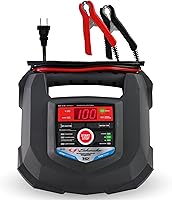
The Schumacher SC1280 suits a home garage charging standard, AGM, gel, or deep-cycle lead-acid batteries. Automatic voltage detection and microprocessor control help manage routine charging.
Choose it when your compatible car battery accepts the higher charging rate and you want maintenance afterward. Skip it for LiFePO4 batteries, which are outside its stated supported chemistries.
Its lower-voltage mode uses a lower current, so don't plan a 6V charging session around its maximum output. Automatic voltage detection also does not replace checking the correct battery type setting.
Clore PL2320: for larger batteries and flexible charge rates
The Clore PL2320 suits drivers who charge different lead-acid battery sizes and want a choice of current settings. It supports flooded, AGM, gel, spiral-wound, marine, and deep-cycle lead-acid batteries.
Choose it when a larger battery permits its higher output, or when you want lower settings for other charging jobs. Skip it for lithium batteries or if you only need occasional storage maintenance.
It also has a stable power supply mode for suitable applications. Use the charging mode for recharging a battery, and follow its manual before selecting power supply mode.
Battery Tender 15A: for drivers who want visible progress
The Battery Tender 15A suits drivers who want to see the selected charging rate, battery type, charge percentage, and error messages on an LCD. Its selectable rates let you match charging to a supported battery.
Choose it for compatible lead-acid or LiFePO4 batteries when visible status matters more than the highest output here. Skip it if you need to charge a 6V battery.
It switches to float maintenance after a full charge. Treat the displayed percentage as a progress guide rather than a precise countdown to when the car will be ready.
How should you set up the battery for charging?
Confirm the battery type and follow both manuals before connecting power. Correct connections and settings matter more than saving a few minutes.
- Turn the engine and vehicle accessories off.
- Inspect the battery for swelling, leaks, cracks, or signs of freezing.
- Find the designated charging points and check whether the vehicle requires any special charging steps.
- Place the charger on a stable surface in a ventilated area, away from the battery and ignition sources.
- With AC power disconnected, attach the leads in the order and locations the manuals specify.
- Select the correct voltage, chemistry, and permitted current before starting.
Keep cables clear of fans, belts, hot surfaces, and areas where a hood could pinch them. Use our car battery charging guide for the connection and disconnection steps.
For an AGM battery, confirm the required charging profile instead of assuming any automotive charger will suit it. See whether you can charge an AGM battery with a regular charger before choosing a mode.
Can you leave a car battery charging overnight?
Overnight charging is suitable only when the charger and battery instructions allow it. A smart charger still needs correct settings, secure connections, and a suitable location.
Check that charging begins normally before leaving the setup. Don't use an overnight session to keep retrying a battery that produces a fault or becomes unusually hot.
For longer storage, use a charger designed for automatic maintenance. The difference between a battery maintainer and a battery charger matters when deciding between keeping a full battery ready and restoring a low one.
Read whether you can leave a Battery Tender on all the time before planning a continuous connection. Periodically inspect the battery, leads, and charger as their manuals direct.
Which mistakes waste time or damage the battery?
Wrong settings, excessive current, and repeated recovery attempts can turn a charging job into a battery problem. Avoid these shortcuts:
- Selecting maximum current automatically: use the battery maker's allowed rate, especially for smaller batteries.
- Confusing voltage with chemistry: matching 12V alone does not confirm that the charging profile is suitable.
- Stopping as soon as the engine starts: finish the appropriate charging cycle when practical.
- Assuming a short drive completes charging: recovery depends on driving conditions, electrical loads, and battery condition.
- Using repair modes routinely: follow their restrictions, including any instructions about connected vehicle electronics.
After use, disconnect AC power before removing the leads in the prescribed order. Store the charger dry, inspect its cables, and avoid pulling clamps off by their wires.
What if the battery still won't charge?
Stop when the charger reports a fault or the battery shows damage, rather than adding more charging time. Swelling, leaks, unusual heat, or a strong odor need attention.
Check the manual's fault guidance, selected mode, and lead connections with power disconnected. Don't bypass a fault simply to keep current flowing.
A battery that reaches full charge but quickly goes flat needs further diagnosis. A qualified technician can check the battery and vehicle charging system, including unwanted electrical drain.
How do you decide how long to charge your car battery?
Match the charger to the battery, estimate the missing charge, and allow time for the final stage. If your schedule is too short, arrange another transport option instead of exceeding the battery's permitted current.
Pick NOCO for mixed battery chemistries and temperature compensation, or Schumacher for routine lead-acid charging. Choose Clore for flexible rates on lead-acid batteries, or Battery Tender when an LCD helps you track progress.
If storage care is your main need, compare battery maintainers and chargers for cars, trucks, and boats. The right choice depends on whether you need to restore charge today or keep the battery ready between drives.
Frequently asked questions
How long does it take to charge a car battery with a 10 amp charger?
A partly discharged car battery can need several hours on a 10 amp charger, while a deeply discharged one can take much longer. Replacing 30 amp-hours gives a simple estimate of 3 hours, but charging losses and reduced current near full charge extend the session.
Can a car battery charge overnight?
Yes, overnight charging can be suitable when both manuals allow it and the charger supports the battery's voltage and chemistry. Use a ventilated location, secure the connections, and keep cables away from heat or moving parts; a basic manual charger may require closer supervision and timely disconnection.
Does a car battery charge faster with a higher amp charger?
A higher amp charger can shorten charging time when the battery permits that current, but its maximum output is not the current delivered throughout charging. Choose a rate within the battery maker's limit, and expect the charger to reduce current as the battery approaches full charge.
How long should I charge a dead car battery?
A deeply discharged battery may need many hours or more than a day, and a failed battery may never accept a full charge. Follow the charger's indicators and fault instructions rather than extending charging indefinitely; never charge a frozen, swollen, leaking, or otherwise damaged battery.