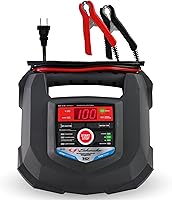
What Size Battery Charger Do I Need?
To work out what size battery charger you need, match voltage and chemistry first, then choose amps within your battery's charging limits. Compare capacity and available charging time to decide whether a lower-output charger or a faster compatible model fits.
On this page (10 sections)
- What size battery charger do I need?
- How can you estimate charging time before buying?
- Does battery type change the charger size?
- How many amps should a car battery charger have?
- What charger size suits trucks and marine batteries?
- Is a high-amp charger safe for a small battery?
- Should I buy a charger or a maintainer?
- How should you set up and care for your charger?
- Which charger-sizing mistakes should you avoid?
- What size battery charger do I need for my setup?
To decide what size battery charger you need, match the battery's voltage and chemistry, then choose a charging current within its allowed range. For routine car charging, compare 5A and 10A models first; consider higher output when battery capacity and your charging window justify it.
Charger size means electrical output, not the size of the case. The right choice also changes with your job: topping up a car overnight, maintaining a motorcycle through winter, or recharging a larger deep-cycle battery.
For a broader comparison of these jobs, see battery maintainers and chargers for cars, trucks and boats.
What size battery charger do I need?
Choose compatible voltage and chemistry first, then use battery capacity, allowed charging current and available time to select amps. A larger charger is useful only when the battery can accept its output.
Start with the battery label and manual. Record its nominal voltage, chemistry, amp-hour capacity and recommended charging current before comparing chargers.
| Your situation | Sensible starting point | Main check |
|---|---|---|
| Stored car that is already charged | Compatible smart maintenance mode | Storage instructions and connected vehicle loads |
| Small motorcycle or lawn mower battery | Suitable low-current charger or setting | Maximum charging current |
| Routine car battery charging | Compare 5A and 10A models | Capacity, chemistry and time available |
| Larger truck or deep-cycle battery | Consider higher output | Battery's allowed charge rate |
| Several batteries with different needs | Compatible selectable modes | Each battery's requirements |
| Boat with multiple batteries | Charger matched to bank layout | System voltage and charging connections |
Do not choose by vehicle size alone. Two cars can have different batteries, while a motorcycle battery may need less current than a charger's main charging mode delivers.
How do I work out what size battery charger I need from Ah?
Use amp-hours and the battery's allowed charge rate to narrow the choice. If the battery maker specifies a rate as a fraction of capacity, multiply that fraction by the battery's Ah figure.
For example, if a 60Ah battery's instructions call for 0.1C charging, that means 6A. This is an example of reading a manufacturer's rate, not a rule that every 60Ah battery needs 6A.
Do not confuse amp-hours with cold cranking amps, often marked CCA. CCA describes starting performance and cannot be substituted for Ah in a charging-time calculation.
If the label gives only starting figures, find the battery model's charging guidance. Guessing capacity from CCA can lead you to the wrong output.
How can you estimate charging time before buying?
Divide the amp-hours you need to replace by charger amps for a rough starting estimate. Allow extra time because losses and reduced current near full charge make the actual session longer.
A 60Ah battery at roughly half charge needs about 30Ah replaced. At a constant 5A, that would take 6 hours; at a constant 10A, it would take 3 hours.
Those figures explain the tradeoff between charger sizes, but they are not completion promises. Battery condition, temperature, connected loads and the charger's charging stages affect the wait.
Also distinguish total capacity from the amount missing. A partly discharged 80Ah battery does not need its full capacity replaced every time you connect a charger.
If you have all night, a lower-output compatible charger may meet your needs. If you often need the vehicle again after a few hours, higher output becomes more useful.
A charger cannot guarantee a same-day recovery of a neglected battery. See how long it takes to charge a car battery for more help planning the charging window.
Does battery type change the charger size?
Yes, chemistry determines the required charging profile, while capacity and permitted current guide output. Matching nominal voltage is only the first compatibility check.
Flooded lead-acid, AGM and gel batteries can have different charging requirements. Use the mode specified for your battery rather than assuming every lead-acid setting is interchangeable.
Lithium batteries need explicit support for their chemistry and configuration. A charger with a LiFePO4 mode is not automatically suitable for other lithium batteries.
The NOCO Genius5 and Genius10 support 6V and 12V lead-acid batteries, including AGM and gel, plus LiFePO4 batteries. Select the mode that matches the battery and follow the voltage-specific instructions.
The Schumacher and Clore models below cover lead-acid charging needs. Choose a model with explicit LiFePO4 support if that is the battery you need to charge.
Read whether you can charge an AGM battery with a regular charger if your existing charger has no clear AGM guidance.
How many amps should a car battery charger have?
For routine home charging, compare 5A and 10A models against your battery's requirements. Choose the lower output when time is flexible, or the higher compatible output when you regularly need a shorter charging window.
The following two models suit buyers who want charging and maintenance in one device. Their difference in output matters most when replenishing charge, rather than keeping an already charged battery ready.
NOCO Genius5: for overnight charging and storage
The NOCO Genius5 is the choice to consider when you can leave a compatible battery charging for several hours and want maintenance afterward. NOCO specifies charging support for batteries up to 120Ah.
Its integrated thermal sensor adjusts charging for ambient temperature. That helps account for changing garage conditions, although the battery and charger must still stay within their permitted operating temperatures.
Included clamps and integrated eyelet terminals offer two connection options. Eyelets can make repeat connections more convenient on an accessible battery when installed and routed according to the instructions.
Choose it for occasional car top-ups or seasonal battery care when its supported range fits. Skip it if you routinely remove substantial charge from a larger battery and need to replenish it in a short window.
Do not assume its maximum supported capacity means every battery below that figure is suitable. Small batteries still need a compatible charging current and mode.
NOCO Genius10: for shorter charging windows
The NOCO Genius10 makes more sense when recharge time matters and the battery accepts its higher current. NOCO specifies charging support for batteries up to 230Ah.
Like the smaller NOCO, it includes temperature compensation and maintenance functions. Its appeal is the extra charging output, rather than a different reason to buy a maintainer.
Choose it for a larger compatible battery or frequent charging sessions where waiting matters. Skip it if you only maintain a charged seasonal vehicle or your small battery requires less current.
Both NOCO models can begin charging at low battery voltage and offer Force Mode. Treat that as a special procedure requiring the manual, not a routine shortcut when a battery fails to respond.
What charger size suits trucks and marine batteries?
Choose by actual battery capacity and bank layout, rather than assuming every truck or boat needs the largest charger. Higher current can help with larger batteries that allow it.
A truck with more than one battery needs extra attention to its wiring. A boat may have separate starting and house batteries with different charging needs.
Schumacher SC1280 15A: for routine lead-acid garage charging
The Schumacher SC1280 15A suits buyers who want automatic charging for compatible lead-acid batteries without needing lithium support. It has automatic voltage detection and microprocessor control.
Its 3A maintenance mode supports storage care after charging. The distinction between charging and maintenance modes matters: a maintenance figure is not a substitute for checking the battery's permitted charging current.
Choose it for compatible car, truck or seasonal-vehicle batteries when its automatic operation fits your routine. Skip it for LiFePO4 batteries or when you need an explicitly selectable lower charging rate for a small 12V battery.
Do not assume automatic voltage detection also chooses the correct chemistry for every battery. Confirm the operating steps before connecting it.
Clore PL2320 20A: for different charging jobs
The Clore PL2320 20A suits buyers who need selectable current for several compatible lead-acid batteries. It supports flooded, AGM, gel, spiral-wound, marine and deep-cycle types.
Its rate selection is useful when your garage includes batteries with different allowed currents. The highest setting is an option for suitable batteries, rather than the default for every charging session.
The Clore also has a power supply mode for maintaining system voltage during appropriate work. Follow its instructions for that separate function instead of treating it as an ordinary charging mode.
Choose it when you will use its selectable rates or power supply function. Skip it if you need LiFePO4 support or simply want to maintain one stored battery.
Compare vehicle-focused options in best battery chargers for trucks and best marine battery chargers.
Check bank voltage before choosing output
Series and parallel connections change what the charger sees. Two 12V batteries connected in series form a nominal 24V bank; two matched batteries connected in parallel remain nominally 12V.
For a parallel bank, total capacity and connected loads affect charging needs. For a series bank, a 12V charging mode does not match the whole bank's voltage.
Use the bank and charger instructions for the intended connection. Do not improvise a connection across part of an installed bank.
Is a high-amp charger safe for a small battery?
Use a high-output charger on a small battery only when its permitted mode fits that battery's charging limits. Automatic control does not prove compatibility with every low-capacity battery.
A charger may reduce current as a battery fills, yet still apply too much current earlier in the session. Check its supported capacity range and the battery's current limit before relying on that behavior.
Selectable current helps only when the selected setting is suitable. A lower maintenance mode also does not necessarily mean the charger offers a lower initial charging rate.
For a small powersport battery, prioritize a clearly compatible charging mode over spare output for a future vehicle. If no suitable mode is documented, choose another charger.
Should I buy a charger or a maintainer?
Choose a charger to replace missing charge, and a maintainer to keep a charged battery ready during storage. A combined smart model can handle both jobs when it supports your battery.
Storage alone rarely justifies buying the highest charging output. Maintenance behavior, compatible capacity and suitable connections matter more once the battery is full.
Connected alarms, trackers and other vehicle loads can affect storage charging. If the battery keeps losing charge, investigate the battery and vehicle rather than repeatedly increasing charger size.
Our battery maintainer vs battery charger guide explains which role fits your use. For seasonal preparation, see how to winterize a car for storage.
How should you set up and care for your charger?
Confirm the battery, select the correct mode and follow the connection sequence in both manuals. A suitable charger still needs sound connections and a safe charging location.
- Inspect the battery first. Do not charge a frozen, swollen, cracked or leaking battery.
- Prepare the area. Use a stable, ventilated location away from flames and sparks, within the charger's weather and temperature limits.
- Inspect the leads. Look for damaged insulation, loose terminals and dirty connection points.
- Connect with AC power off. Follow the vehicle and charger instructions for polarity and the specified connection points.
- Confirm the mode. Check voltage, chemistry and any selected current before starting.
- Monitor the session. Check that the charger recognizes the battery and proceeds normally; follow the manual for completion and disconnection.
For the full connection process, read how to charge a car battery. For a repeat storage setup, see how to hook up a battery tender.
Keep the charger positioned so air can circulate and leads cannot touch belts, fans or hot parts. Route cables clear of sharp edges and avoid pinching them under a hood.
Inspect permanent eyelet connections periodically for looseness or corrosion. Store disconnected leads clean and dry, and replace damaged parts rather than covering damaged insulation and continuing use.
If you notice unusual heat, swelling, leakage or odor, stop charging using the manual's shutdown procedure. Have the battery checked before another charging attempt.
Which charger-sizing mistakes should you avoid?
The biggest mistake is buying for maximum amps before checking compatibility. Several other shortcuts can waste time or leave you with a charger that does not fit the job.
- Using engine size as battery capacity. Read the battery's own specifications.
- Treating a capacity ceiling as a speed promise. A charger can support a battery yet take longer than your schedule allows.
- Expecting double the amps to halve the whole session. Current tapers near full charge, so the final stages still take time.
- Ignoring connected loads. Power used by the vehicle leaves less charger output available to replenish the battery.
- Confusing charging with jump-starting. These are different jobs; do not expect charging output to provide instant engine-starting power.
- Using repair modes as routine charging. Follow the chemistry and vehicle restrictions for any special recovery function.
A battery that repeatedly goes flat needs diagnosis. A larger charger can replenish charge faster, but it cannot correct a failed battery or an unwanted vehicle drain.
What size battery charger do I need for my setup?
Choose the lowest output that meets your charging window within the battery's limits. That gives you a practical decision rule without paying attention to maximum amps alone.
Pick the NOCO Genius5 for compatible batteries when overnight charging and storage care cover your needs. Pick the NOCO Genius10 when the battery accepts more current and shorter charging sessions matter.
Choose the Schumacher SC1280 15A for automatic lead-acid charging when its operating modes fit your garage routine. Choose the Clore PL2320 20A when selectable current or its power supply function serves a specific job.
For a small battery, let its current limit lead the choice; for a truck or boat, verify capacity and bank wiring first. Use our truck charger guide to compare options once those requirements are clear.
Frequently asked questions
What amp battery charger do I need for a car?
A 5A or 10A smart charger is a useful starting point for routine car charging, provided your battery permits that current; choose by battery capacity and chemistry rather than engine size. Higher output helps when you need a shorter wait, but only within the battery's allowed charging range.
Is a higher amp battery charger better?
A higher amp charger is better when your battery accepts the extra current and charging time matters; it offers little benefit for storage maintenance alone. Compare supported battery capacity, chemistry and selectable modes before choosing, because maximum output does not show how suitable a charger is for every battery.
Can I use a 10 amp charger on a small battery?
Use a 10A charger on a small battery only when both manuals allow that combination of capacity, chemistry and charging mode; automatic control does not make every charger suitable for every battery. If the battery requires a lower current, choose a compatible lower-output model or an approved low-current setting.
What size charger do I need to maintain a battery?
For maintenance, choose a smart charger or maintainer that supports your battery's voltage, chemistry and capacity, with instructions permitting storage use; maximum charging amps matter less than suitable maintenance control. Account for any connected vehicle loads, and inspect the battery and connections during storage as the manuals direct.