Can You Charge an AGM Battery With a Regular Charger?
You can charge an AGM battery with a regular charger if it supports AGM batteries and meets your battery's charging requirements. Match the voltage, current, and charging profile before connecting.
On this page (7 sections)
- Can you charge an AGM battery with a regular charger?
- What settings make a charger suitable for AGM?
- Which AGM-compatible charger fits your use?
- Which charging mistakes should you avoid?
- Can you leave an AGM battery connected during storage?
- What should you do if the battery won't charge?
- Should you keep your regular charger or replace it?
You can charge an AGM battery with a regular charger if the charger supports AGM batteries and meets the battery's charging requirements. A matching 12V label is only the first check; the charging current and voltage control must also suit the battery.
AGM batteries are sealed lead-acid batteries with electrolyte held in a fiberglass mat. They don't need routine water topping, but overcharging can make them vent and lose moisture you can't replace.
Can you charge an AGM battery with a regular charger?
Yes, with confirmed AGM compatibility. A general-purpose automatic charger can work well if its instructions include AGM batteries and its settings match your battery's limits.
A separate AGM button isn't always necessary because some chargers support AGM through a shared charging program. Use that program only when the manual confirms it suits your battery type.
An older manual charger deserves closer scrutiny because it may require you to control charging time or stop the charge yourself. If you can't confirm a suitable charging profile, choose another charger.
For the connection process, read how to charge a car battery. Keep the vehicle's instructions nearby too, since some vehicles have dedicated charging points.
What settings make a charger suitable for AGM?
Match battery voltage, permitted charging current, and charging profile before considering extra features. The battery maker's instructions set the limits, even when the charger offers several modes.
Check these points before connecting:
- Voltage: Use the mode that matches the battery's nominal voltage.
- Current: Stay within the battery maker's recommended charging range.
- Charging stages: Confirm the charger controls the main charge, finishes it correctly, and supports maintenance if needed.
- Temperature: Follow the allowed operating range and any temperature-related charging guidance.
Don't choose current from vehicle size alone. A small motorcycle AGM and a large deep-cycle AGM can need different charging rates, even though both are 12V batteries.
Our guide to what size battery charger you need explains how capacity affects the choice. A battery's amp-hour capacity describes stored charge; it isn't the same as the charger's output in amps.
How to charge an AGM battery with a regular charger
Start with an undamaged battery and a compatible charging mode. Don't attempt to charge a frozen, swollen, leaking, or unusually hot battery.
- Turn off the vehicle and accessories, then inspect the battery, terminals, and cables.
- Place the charger on a stable surface in a ventilated area, away from flames and sparks.
- With AC power disconnected, attach the leads in the order and at the points specified by the vehicle and charger manuals.
- Select the correct voltage and battery program, then start charging as directed.
- Check for faults, unusual heat, swelling, leakage, or unusual smells during charging.
- When finished, disconnect AC power before removing the leads in the prescribed order.
Keep cables clear of belts, fans, sharp edges, and surfaces that become hot. Don't close a hood or door onto a charging lead.
For recurring connections, our guide to how to hook up a battery tender explains clamps and permanent leads. Use only connectors approved for your charger.
Which AGM-compatible charger fits your use?
Choose CTEK for seasonal 12V care, NOCO for mixed-voltage needs, or Schumacher for a garage that also needs engine-start assistance. All 3 support AGM, but their extra functions serve different jobs.
CTEK NXT 5 for seasonal vehicles and regular upkeep
The CTEK NXT 5 suits drivers who want automatic charging and maintenance for a car, motorcycle, or stored seasonal vehicle. Its included U-terminal connector supports a permanent battery connection, which helps when access is awkward.
It supplies 4.3A and supports 12V lead-acid and LiFePO4 batteries across a stated capacity range of about 1.2Ah to 160Ah. Select the correct program for the actual battery rather than treating that range as permission to use any mode.
Automatic temperature compensation adjusts charging voltage as conditions change. Reverse-polarity protection and an IP65-rated housing are useful features, though placement must still follow CTEK's instructions.
Skip it if you need 6V charging or engine-start assistance. Its moderate output also calls for patience with a large, deeply discharged battery.
The CTEK NXT 5 includes desulphation and Recond functions, but use recovery programs only when both battery and charger instructions permit them.
NOCO Genius5 for different batteries around the home
The NOCO Genius5 suits a household with batteries of different voltages or chemistries. Its 5A output supports 6V and 12V lead-acid batteries, including AGM, plus LiFePO4 batteries.
An integrated thermal sensor adjusts charging for ambient temperature. Clamps with integrated eyelet terminals and an included mounting bracket give you options for occasional charging or a recurring setup.
NOCO supports normal charging from as low as 1V and offers Force Mode for batteries down to zero volts. Use that manual function only under the instructions; a very low reading can indicate a failed battery, not merely an empty one.
Skip it if you need an engine-start function or frequent fast turnaround on large batteries. Its recovery features don't guarantee that an old or damaged battery will hold a useful charge.
Schumacher SC1361 for charging and engine-start assistance
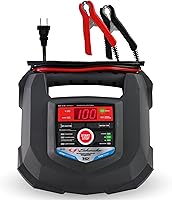
The Schumacher SC1361 suits a garage that needs routine battery care plus a separate engine-start function. It supports standard and AGM 12V batteries with 2A to 6A charging, smart maintenance, 10A boost, and 50A engine-start assistance.
The engine-start figure isn't its continuous charging output. Treat boost and starting as separate procedures, and use them only when the vehicle, battery, and charger instructions allow them.
Reverse hook-up protection prevents operation with reversed clamps. At 9.5 lb, this model makes more sense as a garage tool than a charger you carry between several small vehicles.
Skip it if you need 6V charging or only want storage maintenance without starting features. For the wider choice, compare our best battery chargers for AGM batteries.
Which charging mistakes should you avoid?
Avoid wrong modes, excessive current, and repeated recovery attempts. These mistakes can damage a battery even when the charger has automatic controls.
Don't confuse AGM with gel or lithium. They require different charging settings, despite sometimes sharing a sealed case or the same nominal voltage.
Don't use “cold,” “boost,” “repair,” or “recondition” as substitutes for AGM mode. Those labels describe different functions and may involve voltages unsuitable for your battery or connected electronics.
Don't assume a battery is full because the engine starts. Starting uses a short burst of energy, while restoring charge takes longer.
Allow the normal charging cycle to finish instead of repeatedly restarting it. For planning, see how long it takes to charge a car battery; capacity, discharge level, and charger output all affect the time.
Can you leave an AGM battery connected during storage?
Yes, if AGM maintenance charging is supported and both manuals allow extended connection. A basic charger that continues pushing current after a full charge isn't suitable for this job.
Use a sound power connection and keep the charger within its allowed operating conditions. Check periodically for loose leads, corrosion, cable damage, charger faults, and changes in the battery's condition.
Maintenance replaces small charge losses during storage; it doesn't repair a failing battery or solve a large electrical drain. Read battery maintainer vs battery charger if you're choosing between those jobs.
Our guide to leaving a battery tender connected all the time covers longer connections. For the basic operating cycle, see what a battery maintainer is.
What should you do if the battery won't charge?
Stop and identify the cause rather than cycling through stronger modes. Disconnect as directed before checking the selected program, terminal contact, and cable condition.
A charger may reject a deeply discharged battery because it can't detect it reliably. Consult its fault guidance before considering a low-voltage recovery function.
If the battery repeatedly faults, loses charge quickly, or becomes unusually hot, have a battery professional assess it. Don't bridge it to another battery merely to bypass the charger's detection checks.
Should you keep your regular charger or replace it?
Keep your regular charger if it supports AGM and matches the battery's requirements. Replace it if compatibility is unclear or its charging controls don't suit the job.
Choose CTEK for seasonal 12V charging and upkeep, NOCO for mixed 6V and 12V needs, or Schumacher when engine-start assistance also matters. Check your battery's permitted current before settling on any model.
To charge an AGM battery with a regular charger safely, the right program matters more than the label on the case. Review how to charge a car battery before making the connections.
Frequently asked questions
Can I charge an AGM battery with a regular 12V charger?
Yes, you can charge an AGM battery with a regular 12V charger if it supports AGM and meets the battery's charging requirements. The voltage label alone isn't enough.
Check the allowed current and charging profile, select the required mode, and follow both manuals for connection and shutdown.
What happens if I charge an AGM battery with the wrong charger?
The wrong charger can leave an AGM battery undercharged or damage it through excessive voltage, current, or heat. Overcharging can cause a sealed battery to vent and lose water that you can't replace.
Watching the charger doesn't make an unsuitable charging profile safe; confirm compatibility before connecting.
Do AGM batteries need a special charger?
AGM batteries need a compatible charging profile, but they don't always need a separate charger made only for AGM. A multi-type automatic charger can work when its instructions confirm AGM support.
Match its voltage and charging current to your battery, and don't assume a cold-weather or repair setting is AGM mode.
Can I leave an AGM battery on a regular charger?
Only leave an AGM battery connected if the charger supports AGM maintenance charging and both manuals allow extended use. A basic charger may keep charging after the battery is full.
Inspect the connections and battery periodically, and read about leaving a battery tender on all the time before storage.