Can You Leave a Battery Tender On All the Time?
Yes, you can leave a battery tender on all the time if it's a compatible smart maintainer approved for continuous use. Match its mode to your battery, follow the charger and vehicle manuals, and inspect the setup periodically.
On this page (7 sections)
- Can you leave a battery tender on all the time during storage?
- Which maintainer suits your battery and storage routine?
- What should you check before leaving a tender connected?
- Can any battery charger stay connected all the time?
- What mistakes can harm a battery during long-term maintenance?
- How should you check a maintainer during storage?
- Should you leave your battery tender on all the time?
Yes, you can leave a battery tender on all the time if it's a compatible smart maintainer approved for continuous use. Match the charging mode to your battery, follow the charger and vehicle manuals, and check the setup periodically.
The key is what happens after charging finishes. A maintainer changes its output to keep a stored battery ready, while a basic charger may keep supplying current when it should be disconnected.
Long-term connection suits a healthy battery in a parked vehicle. It won't repair a failing battery or fix a fault that keeps draining it.
Can you leave a battery tender on all the time during storage?
You can leave a compatible smart maintainer connected throughout storage when its instructions permit it. Continuous maintenance still needs periodic checks, especially after a power outage, a move, or a change in weather.
Winter storage is a common use because the vehicle may sit for weeks without charging from normal driving. The maintainer replaces charge lost while parked, within the limits of its output and the battery's condition.
Cold weather reduces a battery's ability to deliver starting power. Keeping it charged helps, but a weak battery may still need replacement before the vehicle returns to regular use.
For the rest of the storage routine, see how to winterize a car for storage. Battery care works best alongside the vehicle's other storage steps.
What happens when you leave a battery tender on all the time?
A smart maintainer reduces or changes its charging output after the battery reaches its target level. Depending on the design, it may hold a maintenance voltage or monitor the battery and add charge as needed.
A maintenance light shows the charger's current stage, not the battery's remaining life. If the charger never reaches maintenance or repeatedly returns to full charging, check for poor connections, a weak battery, or an electrical drain.
Don't choose a unit by the words “automatic” or “trickle” alone. Its manual must describe a maintenance mode suitable for extended connection.
Which maintainer suits your battery and storage routine?
Choose by battery voltage, chemistry, capacity, and storage conditions before comparing extra features. Charging current matters for refilling a depleted battery, but more amps alone don't make a charger better for long-term maintenance.
Read the battery label rather than guessing from the vehicle type. AGM is a lead-acid design, while LiFePO4 needs a compatible lithium charging mode.
Check the charger's supported battery capacity and charge-current limits against the battery instructions. A unit suitable for a car battery may deliver too much current for a small powersport battery in the wrong mode.
Our guide to choosing the correct battery tender explains these matches in more detail.
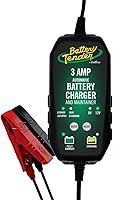
Battery Tender 3A for routine lead-acid storage
The Battery Tender 3A suits a driver who wants automatic charging followed by float maintenance for a supported lead-acid battery. It works with flooded, AGM, and gel batteries, with selectable voltage for older and newer vehicle setups.
Its ring-terminal and alligator-clip combo cable gives you options for repeated seasonal use or temporary connections. Battery Tender backs the charger with a 5-year manufacturer's warranty.
Skip it if your main need is rapid recovery of a large, depleted battery. For lithium use, confirm the exact chemistry and mode in the model's instructions before buying or connecting it.
NOCO Genius5 for varied batteries and changing temperatures
The NOCO Genius5 suits a household maintaining different supported battery types. Its 5A output also makes it useful when you need charging as well as storage maintenance.
An integrated thermal sensor adjusts charging for ambient temperature. NOCO describes the unit as suitable for indefinite maintenance, making it a practical choice for a garage that changes temperature through the season.
Skip it if you need an automatic rescue for every nonresponsive battery. Its manual Force Mode requires deliberate use and isn't a routine storage setting.
CTEK MXS 5.0 for a seasonal car or motorcycle
The CTEK MXS 5.0 suits a seasonal vehicle with a supported 12V lead-acid battery, including AGM. Its automatic 8-step program and 4.3A output cover charging before extended maintenance.
CTEK describes its maintenance system as suitable for months of connection. Its IP65 protection is useful around dust and splashes, though the AC connection still needs suitable protection from moisture.
Skip this model for 6V or lithium batteries. Choose it when its supported battery range matches your vehicle, rather than buying it for the reconditioning feature alone.
What should you check before leaving a tender connected?
Check compatibility, battery condition, connection points, and cable routing before leaving the setup unattended. Make these checks while the charger is unplugged from AC power.
- Read the battery label and select the matching voltage and chemistry mode.
- Check both manuals for capacity limits, connection points, and storage instructions.
- Inspect the battery case, posts, leads, and charger for damage or corrosion.
- Make the connections in the order specified by the manuals.
- Put the charger on a stable surface with airflow around it.
- Route cables clear of sharp edges, hot parts, belts, fans, and closing panels.
- Connect AC power as directed, then confirm the expected charging indicator.
Use a suitable outlet and keep plugs and connections dry. If an extension cord is necessary, follow the charger's limits for cord type, length, and wire size.
Watch the start of the first charging cycle before leaving. A loose clamp or incorrect mode is easier to catch while you're beside the vehicle.
For detailed connection steps, follow how to hook up a battery tender.
Should the battery stay connected to the vehicle?
Leave the battery installed and connected only when the vehicle and charger instructions permit it. Some vehicles require designated charging points so their battery monitoring system can account for the charge.
Ring terminals can make repeat connections easier, but permanent leads still need secure routing and protection from metal parts. Fit them according to the instructions, including any required fuse arrangement.
Before driving, unplug AC power and disconnect the charging lead in the specified order. Secure any permanent connector so it cannot reach moving parts.
Can any battery charger stay connected all the time?
No, only use continuous connection with a charger designed for it. A low output does not prove that a device will stop or adjust charging once the battery is full.
A basic trickle charger may supply a steady current for as long as it has power. Read what a trickle charger is before leaving an older device attached through storage.
For a wider comparison, see battery maintainer vs battery charger. Our battery tender vs trickle charger guide explains why the labels can be confusing.
Maintenance and recovery are also different jobs. A deeply discharged battery may need a suitable charging cycle and a condition check before it's ready for long-term maintenance.
If time to recharge matters, how long it takes to charge a car battery explains why capacity, charge level, and charger output all matter.
What mistakes can harm a battery during long-term maintenance?
The main mistakes are using the wrong mode, ignoring warning signs, and treating maintenance as a repair. A charger can manage its output without knowing every problem in the battery or vehicle.
Avoid these habits:
- Guessing the chemistry. Select the mode from the battery label and instructions.
- Using repair modes for storage. Reconditioning and manual recovery modes serve specific tasks and may have extra restrictions.
- Closing a hood on a cable. Pinched insulation can create a fault even when the initial connection worked.
- Ignoring repeated charging cycles. A constant drain may exceed what the maintainer can replace.
- Assuming splash protection covers the whole setup. The outlet, plugs, and extension connection need appropriate protection too.
Never charge a frozen, cracked, swollen, or leaking battery. Stop if you notice unusual heat, smoke, a strong odor, or a change in shape.
Disconnect AC power only if you can do so safely without approaching a hazardous battery. Our guide to whether a battery tender can harm a battery covers these risks further.
How should you check a maintainer during storage?
Check the status light, battery condition, and cable security periodically, using any inspection interval in the manuals. Check again after a power interruption, since the charger may need attention before maintenance resumes.
Look for moisture, damaged insulation, corrosion, or a lead pulled loose. Confirm that the selected mode remains correct and the charger has room to shed heat.
For serviceable flooded batteries, follow the battery manufacturer's electrolyte care instructions. Don't open a sealed battery.
If the battery still struggles to start the vehicle after proper charging, have its condition and the vehicle's charging system checked. See how to use a battery tender for routine operating steps.
Should you leave your battery tender on all the time?
Leave your battery tender on all the time only when continuous maintenance is approved for your exact setup. Choose the Battery Tender 3A for routine supported lead-acid storage, the NOCO Genius5 for varied compatible batteries and temperature adjustment, or the CTEK MXS 5.0 for a seasonal 12V lead-acid vehicle.
If the battery is damaged or keeps losing charge despite maintenance, resolve that problem first. If you still need a unit, compare battery maintainers and chargers for cars, trucks, and boats against your battery's requirements.
Frequently asked questions
Can you leave a battery tender on all the time?
Yes, a compatible smart battery tender can stay connected continuously when its manual permits that use. Match the voltage and battery chemistry, follow the vehicle's connection instructions, and inspect the setup periodically; continuous maintenance does not mean you can ignore damaged cables, warning lights, or changes in the battery.
Is it safe to leave a battery maintainer connected overnight?
Yes, a compatible smart maintainer can stay connected overnight if its instructions allow it. Watch the start of the charging cycle before leaving it unattended, confirm the correct mode, and check for secure connections; stop charging if you notice unusual heat, swelling, leakage, smoke, or a strong odor.
Can a battery tender stay connected during winter storage?
Yes, a maintainer approved for long-term use can remain connected during winter storage with a compatible battery. Keep the charger within its allowed operating conditions and inspect the battery and cables periodically; never charge a frozen battery, and remember that a maintainer cannot repair damage or cure an electrical drain.
Should you disconnect a battery before using a tender?
Disconnect the battery only when the vehicle or charger instructions call for it. Some vehicles require specific charging points so their battery monitoring system can account for the charge; read both manuals before connecting, since disconnecting a vehicle battery can also affect stored settings or require a reset procedure.