NOCO Genius5 Review: Worth It? (October 2026)
The NOCO Genius 5 suits owners who need routine charging and storage maintenance across compatible lead-acid and LiFePO4 batteries. Choose it for battery flexibility and temperature adjustment; consider another charger if your main need is faster charging of a large battery.
On this page (9 sections)
- Who should buy the NOCO Genius 5?
- Which batteries can the Genius5 charge?
- Is 5A enough for your charging routine?
- When should you choose Battery Tender or Schumacher instead?
- How should you set up the Genius5?
- When should you use Force Mode or desulfation?
- How do you care for the charger during long-term maintenance?
- Should you compare the Genius5 with the Genius10?
- Should you buy the NOCO Genius 5?
The NOCO Genius 5 is a useful all-round charger for routine charging and storage maintenance, especially if your household has different compatible battery types. Its strongest case is a car plus a seasonal motorcycle, mower or boat battery that you charge individually.
Buy it for that flexibility and its temperature adjustment. If you mainly need to refill a large, heavily discharged battery quickly, compare higher-output options that stay within your battery's charging limits.
Who should buy the NOCO Genius 5?
The Genius5 suits owners who want one charger to move between compatible vehicles rather than a separate unit for every battery. It also fits a stored vehicle that needs occasional charging followed by ongoing maintenance.
NOCO Genius5: Best for mixed vehicle households

- 5A output
- 6V and 12V batteries
- Lead-acid and LiFePO4 support
- Temperature compensation
A charger and maintainer for households that rotate between compatible vehicle batteries. Temperature adjustment helps it adapt to seasonal storage conditions.
Pros
- Supports several lead-acid types and LiFePO4
- Adjusts charging for ambient temperature
- Includes clamps and eyelet terminals
- Offers manual Force Mode for deeply discharged batteries
Cons
- One charging port means charging batteries individually
- Large discharged batteries need more time than with a suitable higher-output charger
- Force Mode requires careful manual operation
Its single charging port matters if you store several vehicles at once. You can move it between batteries, but keeping multiple batteries connected independently requires a different arrangement.
Skip it if your main need is immediate roadside starting. A plug-in battery charger needs time and AC power, so it serves a different job from a jump starter.
Also skip it if your battery requires a charging profile or current outside its supported range. A familiar vehicle name on the compatibility list never replaces checking the actual battery.
What makes the NOCO Genius 5 useful for storage?
The thermal sensor adjusts charging for ambient temperature, which is useful in a garage that changes with the seasons. Battery charging needs change with temperature, so this feature adds value beyond basic output.
Temperature adjustment doesn't make every storage location suitable. Keep the charger within its operating instructions, allow ventilation and choose a location protected from water and physical damage.
NOCO backs the Genius5 with a 3-year limited warranty. For a wider view of charger styles and storage needs, see our battery maintainers and chargers for cars, trucks and boats.
Which batteries can the Genius5 charge?
The Genius5 supports 6V and 12V lead-acid batteries and compatible LiFePO4 batteries. Start with chemistry and voltage, then check capacity and the battery's allowed charging current.
| Battery type | Genius5 support |
|---|---|
| Flooded lead-acid | Yes |
| AGM | Yes |
| Gel | Yes |
| SLA and VRLA | Yes |
| Deep-cycle lead-acid | Yes |
| LiFePO4 lithium-ion | Yes, with the matching mode |
| Other lithium chemistries | Do not assume compatibility |
NOCO specifies charging for batteries up to 120Ah. That capacity limit helps you screen out unsuitable batteries, but it doesn't promise a quick recharge near the upper end.
Read the label on the battery itself, even if you know the vehicle well. A previous replacement may have changed the chemistry from the vehicle's original battery.
AGM describes a lead-acid battery design; it isn't another name for lithium. Likewise, “deep-cycle” describes how a battery is used and doesn't identify its chemistry by itself.
The guide to charging an AGM battery with a regular charger explains why the charging profile matters. If you're unsure whether you need charging or storage support, start with what a battery maintainer does.
Is 5A enough for your charging routine?
The 5A output suits routine replenishment when your battery permits that current, but a large charge deficit takes time. Choose around your normal use, not just the largest number on a charger.
For a rough example, a 60Ah battery at half charge has about 30Ah to replace. Dividing that deficit by 5A gives 6 hours before allowing for losses and the slower finishing stage, so the full process takes longer.
That estimate is a planning tool, not a promised finish time. Battery age, temperature, condition and the charging profile all affect the result.
A car that sits between weekend drives may mainly need maintenance after an initial charge. A deeply discharged boat battery presents a different task, even if both batteries are compatible.
Small powersport batteries also need care with current selection. Check the battery manufacturer's guidance instead of assuming a charger is suitable simply because it supports the correct voltage.
Use our battery charger size guide to match output to capacity and time available. Repeatedly finding a flat battery also calls for checking its condition and possible vehicle drain.
When should you choose Battery Tender or Schumacher instead?
Choose Battery Tender for storage-focused use and Schumacher for higher-output charging of suitable larger lead-acid batteries. The Genius5 remains the more flexible choice here when LiFePO4 support matters.
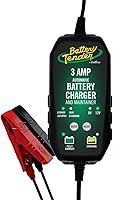
The Battery Tender moves into float mode after charging and resumes full output if battery voltage drops sufficiently under load. Its two-color LED gives you a way to check charging status during storage.
It suits a seasonal vehicle whose battery is already in reasonable condition and doesn't need frequent deep recharging. Skip it if reducing charging time is your main reason for buying.
Battery Tender includes spark-proof lead connection and reverse-polarity detection. Those features help with connection errors, but you still need to identify the terminals and follow the connection instructions.
Its lithium support needs closer checking before you choose it for that purpose. Confirm the exact chemistry and available mode rather than treating the word “lithium” as universal compatibility.
The Schumacher suits a home garage that regularly charges larger standard, AGM, gel or deep-cycle lead-acid batteries. Its higher current is useful only when the battery allows it.
Skip it for LiFePO4 charging or if your small battery's current limit rules out the charging mode you intend to use. Automatic voltage detection doesn't replace checking chemistry and current requirements.
For storage, output alone shouldn't decide the choice. The broader NOCO Genius vs Battery Tender comparison can help you weigh charging flexibility against a maintenance-focused routine.
How should you set up the Genius5?
Set up the Genius5 by confirming the battery requirements, planning the cable route and selecting the matching mode. Read both manuals before connecting power, especially when the battery remains installed in a vehicle.
The package includes a 72-inch AC cable and an 80-inch DC cable with clamps and integrated eyelet terminals. A mounting bracket and screws are also included.
Measure the real route to the outlet and battery, including the distance around obstacles. Cable length on paper can disappear quickly when you route it safely along a wall or around a vehicle.
- Inspect the battery and cables. Don't charge a frozen, swollen, leaking or visibly damaged battery.
- Choose a suitable location. Provide ventilation and keep the charger away from heat, moving parts and places where it could fall.
- Identify the connection points. Follow the vehicle's designated charging points and the charger manual's connection order.
- Connect with AC power unplugged. Keep clamps secure and prevent the leads from touching each other.
- Select the correct charging mode. Match chemistry and voltage, then confirm the indicator shows the intended setting.
- Check the initial charge. Watch for fault indications, unusual heat or a loose connection before leaving it for longer.
Clamps make sense when you move the charger between vehicles. Eyelet terminals suit a battery you connect often, provided they're installed and routed according to the instructions.
Don't guess at terminal hardware tightness or attach leads where they can rub through. Use our battery tender hookup guide for connection planning and how to charge a car battery for preparation.
When should you use Force Mode or desulfation?
Use Force Mode only after checking the battery and reading its instructions. It is a manual charging option for a deeply discharged compatible battery, not a routine shortcut.
The Genius5 can start normal charging from as low as 1V, while Force Mode allows charging down to zero volts. A very low reading can reflect serious battery trouble, so recovery is never assured.
If the charger doesn't recognize a battery, first check the connections, selected mode and battery condition. Don't jump straight to a manual recovery mode to bypass an unexplained problem.
NOCO says its pulse charging can reverse sulfation and acid stratification in lead-acid batteries. Consider that a possible recovery aid rather than a reason to keep charging a battery that won't hold a useful charge.
Desulfation is relevant to lead-acid batteries, not a general treatment for lithium batteries. Use only the functions approved for the battery chemistry.
A battery that charges but soon goes flat needs further attention. The cause may be battery wear or a vehicle electrical drain, neither of which ongoing charging automatically fixes.
How do you care for the charger during long-term maintenance?
For storage, start with a suitable battery, secure connections and periodic checks. NOCO says the Genius5 can remain connected indefinitely while monitoring and maintaining a compatible battery.
That makes it useful for a vehicle parked through a season, but inspection still matters. Check for cable damage, loose terminals, corrosion and changes in the battery's condition.
Keep cables clear of tires, hinges, belts and hot parts. Position the charger where tools or stored items won't cover it or knock it down.
Before cleaning or moving the charger, disconnect it as directed in the manual. Store the leads without sharp bends, and replace damaged components rather than covering worn insulation and continuing to charge.
The main mistakes to avoid are:
- Selecting by vehicle alone. Check the battery's chemistry and charging limits.
- Using extra current to save time. Stay within the battery's allowed charge rate.
- Treating recovery as routine care. Find out why a battery repeatedly becomes deeply discharged.
- Ignoring fault indicators. Resolve the cause before resuming charging.
- Leaving cables where they can be crushed. Recheck the route before closing a hood or moving the vehicle.
Read whether you can leave a battery tender connected when planning a long storage period. A sound setup matters as much as the maintainer you choose.
Should you compare the Genius5 with the Genius10?
Compare the models if your battery size or recharge schedule makes output a deciding factor. First write down the battery chemistry, voltage, capacity and maximum allowed charging current.
Then decide how long you can leave the vehicle connected. A charger that suits overnight replenishment may feel slow if you regularly need a large battery ready within a shorter window.
Use our NOCO Genius5 vs Genius10 comparison to check the model differences against that list. Paying for a different model only helps if its capabilities match a need your battery and routine actually have.
Should you buy the NOCO Genius 5?
Choose the NOCO Genius 5 for a mix of compatible vehicle batteries, especially when you want one unit for charging, seasonal maintenance and LiFePO4 support. Allow enough time for larger batteries and remember that its single port serves one battery at a time.
Choose Battery Tender for a storage routine centered on compatible batteries that need modest replenishment. Choose Schumacher when a larger lead-acid battery permits its higher current and charging time matters more.
Before ordering, make your final check against the battery label and manual. Then use our battery charger size guide to confirm that the charger fits both the battery and the time you have.
Frequently asked questions
Can the NOCO Genius5 charge a dead battery?
The NOCO Genius5 can begin charging compatible batteries from 1V, and manual Force Mode supports charging down to zero volts. Recovery still depends on battery condition.
Inspect the battery first, follow the manual, and don't attempt to charge a frozen, leaking, swollen or otherwise damaged battery.
Does the NOCO Genius5 work with lithium batteries?
The NOCO Genius5 supports LiFePO4 lithium-ion batteries, but that doesn't make it suitable for every lithium chemistry. Check the battery label, voltage and charging instructions before connecting it.
Select the matching mode, and follow any additional charging limits or requirements set by the battery manufacturer.
Can you leave the NOCO Genius5 connected?
NOCO says the Genius5 can remain connected indefinitely for maintenance while it monitors a compatible battery. Set it up according to both manuals and inspect the battery, connections and cables periodically.
Stop charging if you notice unusual heat, damage or an unusual smell, even if the charger appears to operate normally.
Is the NOCO Genius5 a battery maintainer or a charger?
The NOCO Genius5 is both a charger and a maintainer for compatible batteries. Charging replaces energy the battery has lost, while maintenance keeps a charged battery ready during storage.
It also includes a desulfation function, though that feature cannot repair physical damage or guarantee recovery of a worn battery.