How to Charge a Lawn Mower Battery
Choose a battery charger for a lawn mower that matches its battery voltage, chemistry, and allowed charging current. Follow the mower and charger manuals for connections, select the correct mode, and let an automatic charger finish.
On this page (7 sections)
- How do you choose a battery charger for a lawn mower?
- How do you charge a lawn mower battery step by step?
- What charger setting should you use?
- How long does a mower battery take to charge?
- What mistakes cause trouble during mower battery charging?
- How do you care for a mower battery during storage?
- Which battery charger for a lawn mower should you choose?
A battery charger for a lawn mower should match the battery's voltage, chemistry, and allowed charging current. Follow the mower and charger manuals for connections, choose the correct mode, and let an automatic charger finish.
Many riding mowers use a 12-volt lead-acid starting battery, but that doesn't cover every mower. A removable lithium pack from a cordless mower needs its approved charging system; don't assume an automotive charger will work.
How do you choose a battery charger for a lawn mower?
Choose by battery compatibility first, then decide whether you need to recharge one battery, maintain it during storage, or care for two batteries together. More charging amps are useful only when the battery permits them.
Read the battery label for voltage and chemistry, then check its instructions for charging-current limits. Flooded lead-acid, AGM, gel, and LiFePO4 need suitable charging modes, even when their nominal voltage matches.
Battery capacity in amp-hours helps you judge charging time, but it isn't the same as cold cranking amps. If the label shows only starting power, use the battery model number to find its charging guidance.
For help matching current to capacity, see what size battery charger you need. Don't choose a high-output car charger simply because its clamps fit.
An automatic maintenance mode helps when a mower sits between cuts or through winter. Our battery maintainer vs battery charger guide explains the difference, while how to choose the right battery tender or maintainer covers selection.
Which lawn mower battery charger suits one battery?
The NOCO Genius5 suits a one-mower household that also wants charging options for other compatible batteries. Its broader chemistry support makes it useful when the garage contains different battery types.
It has an ambient-temperature sensor, battery clamps, and integrated eyelet terminals. Clamps suit occasional connections, while properly installed eyelets can make repeat seasonal connections easier.
Skip it if your battery requires less charging current than this model supports, or if you need two batteries connected at once. Neither extra modes nor recovery features justify exceeding the battery's charging limit.
When does the CTEK MXS 5.0 make sense?
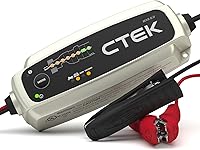
The CTEK MXS 5.0 suits a compatible lead-acid mower battery that needs regular charging and long storage maintenance. Its narrower voltage range makes it a focused choice for an established battery setup.
Its 8-step process leads into float/pulse maintenance, which CTEK supports for months of connection. That suits a stored mower when the battery and mower instructions also allow ongoing maintenance.
Skip it for a 6-volt battery, lithium battery, or a battery with a lower allowed charging rate. Its splash and dust protection doesn't replace a sheltered charging location.
How do you charge a lawn mower battery step by step?
Charge with the mower off, the correct charger mode selected, and connections made in the prescribed order. Prepare the area before attaching leads so you don't need to move equipment during charging.
- Park on a level surface in a dry, ventilated area, away from flames, sparks, and fuel handling.
- Turn off the mower, remove the key, and let the engine and exhaust cool.
- Inspect the battery and cables. Don't charge a cracked, leaking, swollen, or frozen battery.
- Confirm whether charging in place is allowed. If removal is required, follow the mower's cable-disconnection and lifting instructions.
- Keep the charger unplugged while attaching leads. Use the connection points and sequence specified by the mower and charger manuals.
- Select the required voltage and battery mode at the stage directed by the charger manual, then start charging.
- Check for fault indicators, unusual heat, swelling, or a strong odor. Stop charging if any appear.
- At completion, turn off and unplug the charger before removing its leads in the instructed order.
Wear eye protection and remove metal jewelry before working near exposed terminals. Keep tools from bridging the terminals, and never let the charger clamps touch each other.
Place the charger on a stable surface away from the battery's vent openings. Route cords clear of belts, blades, sharp edges, hot parts, and places where someone could trip.
Can the battery stay installed?
The battery can stay in the mower when both manuals permit it and the connection points are safely accessible. Charging in place avoids lifting the battery, but it still requires correct cable routing.
Don't substitute a convenient bolt for a specified ground connection. For more connection detail, read how to hook up a battery tender.
What charger setting should you use?
Use the voltage and chemistry mode shown in the battery instructions, then confirm the selection before charging. Repair, recovery, and engine-start modes aren't substitutes for the normal charging mode.
An AGM battery needs a charger mode approved for it. Our guide to charging an AGM battery with a regular charger explains why matching voltage alone isn't enough.
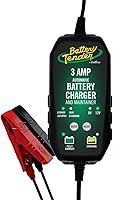
The Battery Tender 3A suits routine lead-acid battery care when you want selectable voltage and automatic float maintenance. It supports flooded, AGM, and gel batteries, includes ring-terminal and clamp connections, and uses a two-color status light.
Its combined cord reach is 11 feet, useful when planning a storage spot near an outlet. Measure the route around the mower rather than the straight-line distance.
Skip it if your battery requires a lower charging current or you need two banks. For lithium use, confirm the exact supported chemistry and mode before choosing this model.
Maintenance mode keeps a charged battery ready between uses. It doesn't solve repeated charge loss; see what a battery maintainer is for its proper role.
How long does a mower battery take to charge?
Allow time based on how much charge is missing, then use the charger's completion indicator. A partly depleted battery needs less time than the same battery after a deep discharge.
As a rough example, replacing 10 amp-hours at 2 amps starts with a 5-hour calculation. Real charging takes longer because of losses and reduced current near full charge.
If the charger reports a fault or never reaches completion, check its instructions rather than letting it run indefinitely. Our guide to charging a car battery explains the same basic charging stages.
The NOCO Genius2X2 suits shared seasonal storage, such as a mower beside a motorcycle. It supports 6-volt and 12-volt lead-acid and LiFePO4 batteries, with two 10-foot DC extension cables for positioning.
Its benefit is keeping two batteries connected without moving one set of leads between them. Set up each bank for its attached battery and follow NOCO's connection instructions.
Skip it if you care for only one battery or need faster charging of a battery that allows more current. Its total output doesn't combine into one higher-current bank.
What mistakes cause trouble during mower battery charging?
The main mistakes are choosing the wrong mode, exceeding the allowed current, and treating every dead battery as recoverable. Verify the battery's requirements before relying on automatic controls.
Don't confuse a cordless mower's lithium pack with a LiFePO4 starting battery. “Lithium” covers different battery systems, and compatibility must be explicit.
Don't use force mode just because a charger won't detect the battery. Both NOCO models offer low-voltage recovery options, but a deeply discharged battery may have damage that charging cannot reverse.
Stop if the battery becomes unusually hot, swells, leaks, or repeatedly triggers a fault. Have persistent charge loss checked for battery failure, poor connections, unwanted electrical draw, or a mower charging-system problem.
Avoid topping up repeatedly without addressing that cause. Reconditioning features also cannot guarantee recovery of a worn-out battery.
How do you care for a mower battery during storage?
Store the battery charged and maintained as its manual directs, rather than leaving it discharged until spring. Clean and secure the terminals, and check stored equipment periodically.
Use long-term maintenance only when the charger supports it and the battery instructions permit it. Review whether you can leave a battery tender on all the time before setting up a winter connection.
Check cords for damage and keep connection points dry. If you remove the battery, protect its terminals from metal objects and follow its storage-temperature guidance.
Read how to use a battery tender for ongoing care, or compare battery maintainers for seasonal storage if that is your main need.
Which battery charger for a lawn mower should you choose?
Choose your battery charger for a lawn mower by the job it must do, after confirming battery compatibility. Use these decision rules:
- NOCO Genius5: choose it for one battery and flexibility across supported battery types.
- CTEK MXS 5.0: choose it for a compatible lead-acid setup with long storage periods.
- NOCO Genius2X2: choose it when two compatible batteries need care at the same time.
- Battery Tender 3A: choose it for routine charging and float maintenance when its output fits your battery.
If none matches the battery's allowed current or chemistry, choose a different charger. Before the first connection, use how to hook up a battery tender alongside your equipment manuals to plan the setup.
Frequently asked questions
Can you charge a lawn mower battery without removing it?
Yes, if the mower and charger manuals allow charging with the battery installed; turn off the mower, remove the key, and let hot parts cool before connecting anything. Remove the battery if required, and route charging leads away from belts, blades, sharp edges, and hot surfaces.
How long does it take to charge a lawn mower battery?
Charging time depends on battery capacity, the amount of charge missing, temperature, and charger output; dividing the missing amp-hours by charging amps gives a rough starting estimate, but the final charging stage adds time. Use the charger's completion indicator rather than treating that estimate as a deadline.
Can I use a car battery charger on a lawn mower battery?
Yes, if its voltage, battery mode, and charging current match the mower battery's requirements; a car charger's high-current or engine-start setting may be unsuitable for a small mower battery. Check the allowed charging rate in the battery instructions instead of choosing a setting by vehicle size.
Should I disconnect a lawn mower battery before charging?
Disconnect it if the mower manual requires isolation or removal before charging; if charging in place is allowed, follow the specified connection points and sequence. On a negative-ground system, the mower's negative battery cable normally comes off first and goes back on last when removing and reinstalling the battery.