10 Best Battery Maintainer (October 2026)
The best battery maintainers for cars and seasonal storage include the NOCO Genius5 for most drivers, the CTEK MXS 5.0 for seasonal car storage, and the NOCO Genius10 for larger battery recharging.
On this page (7 sections)
- Which best battery maintainer fits your storage routine?
- How do you choose the right battery maintainer?
- When should you use a maintainer instead of a charger?
- How do you set up a maintainer for storage?
- How do you keep a battery safe during storage?
- Which battery maintainer mistakes should you avoid?
- Which best battery maintainer should you buy?
The best battery maintainer for most drivers is the NOCO Genius5, because it combines flexible battery support with enough charging output for occasional recharging. Choose the CTEK MXS 5.0 for a dedicated lead-acid storage routine, or the NOCO Genius10 when larger compatible batteries need charging as well as upkeep.
The right choice depends on what happens before storage: a healthy, charged battery needs small top-ups, while a depleted battery needs a proper recharge first. Extra starting and diagnostic functions matter only if you'll use them.
For vehicle-specific choices, see our guide to battery maintainers and chargers for cars, trucks and boats.
Start with what a battery maintainer does if you're unsure which job you need, or review how to use a Battery Tender before connecting one.
Our picks at a glance
-
1

-
2

-
3

Which best battery maintainer fits your storage routine?
Choose the Genius5 for general use, the MXS 5.0 for focused seasonal storage, or a higher-output charger when recharging is a regular job. We compared battery compatibility, charging output, connection options and storage functions, with priority given to practical maintenance needs.
NOCO Genius5: Best for most drivers
- 5A output
- 6V and 12V
- Lead-acid and LiFePO4 support
- Temperature compensation
A flexible choice for drivers who need seasonal maintenance and occasional recharging across different vehicles. Includes clamps, integrated eyelet terminals and a mounting bracket.
Pros
- Supports several battery chemistries
- Adjusts charging for ambient temperature
- Temporary and permanent connection options
Cons
- Force Mode needs careful manual setup
- Less charging output than Genius10 for larger compatible batteries
The NOCO Genius5 suits a household where one charger moves between a car, mower, motorcycle or other compatible vehicle. Its 5A output, selectable 6V and 12V operation, and lead-acid and LiFePO4 support cover a broad range of battery needs.
Temperature compensation adjusts charging for ambient conditions, which helps when your storage space changes with the seasons. That feature supports a routine where the charger stays near the vehicle rather than moving into a heated room.
Included clamps work for occasional connections, while integrated eyelet terminals suit a battery you maintain often. A mounting bracket gives you another way to organize a regular charging spot.
Skip it if your main job is repeatedly recharging large batteries whose allowed charge rate supports more output. For a mostly charged car in storage, though, there is little reason to choose a larger charger solely for its amp figure.
CTEK MXS 5.0: Best for seasonal car storage
- 4.3A output
- 12V lead-acid and AGM support
- 8-step automatic charging
- Float and pulse maintenance
A focused choice for keeping a compatible car or motorcycle battery charged through months of storage. CTEK combines automatic charging with float/pulse maintenance.
Pros
- Automatic 8-step charging
- Float and pulse maintenance
- IP65 splash and dust protection
Cons
- No 6V support
- Not a choice for lithium batteries
The CTEK MXS 5.0 is a strong fit for a seasonal car or motorcycle with a 12V lead-acid battery, including AGM. Its automatic 8-step process and float/pulse maintenance suit a vehicle parked for months between outings.
The 4.3A output makes this a charging-and-storage tool rather than an engine-start device. Choose it when your priority is bringing a compatible battery to full charge and keeping it ready while the vehicle sits.
Its IP65-rated housing provides splash and dust protection, but you still need a suitable location for the charger and its electrical connections. A protected shelf or mounting area is more useful than leaving equipment on a damp floor.
Skip the MXS 5.0 if you need lithium or 6V support. CTEK includes a reconditioning function for suitable batteries, but routine storage care shouldn't depend on reviving a battery that already struggles to hold charge.
NOCO Genius10: Best for larger battery recharging
- 10A output
- 6V and 12V
- Lead-acid and LiFePO4 support
- Temperature compensation
Choose this for larger compatible batteries that need a recharge before storage. It combines higher charging output with automatic maintenance and temperature compensation.
Pros
- More charging output than Genius5
- Broad battery chemistry support
- Includes clamps and eyelet terminals
Cons
- Extra output adds little to simple top-up duty
- Small batteries may require a lower charging rate
The NOCO Genius10 suits buyers who regularly recharge larger compatible batteries before storage. Its 10A output gives it more charging capacity than the Genius5, provided your battery allows that rate.
It supports 6V and 12V lead-acid batteries and compatible LiFePO4 batteries, with temperature compensation for changing ambient conditions. NOCO describes support for batteries up to 230 Ah, so check capacity alongside chemistry when choosing it.
Both NOCO models can begin normal charging from 1 volt and offer manual Force Mode down to zero volts. That is a recovery option requiring the manual's procedure, not a reason to connect an unknown or damaged battery.
Choose the Genius10 for regular charging work on suitable larger batteries, including compatible deep-cycle uses. Skip the upgrade for a small battery or a storage vehicle that starts each season fully charged, because extra charging capacity adds little to that job.
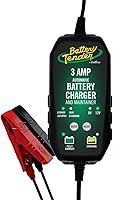
Battery Tender 3A: Best for simple storage upkeep

- 3A output
- Switchable 6V and 12V
- Lead-acid, AGM and gel support
- Ring terminal and clamp cable
A straightforward option for keeping a compatible, mostly charged battery ready between outings. The combo cable supports clamps or an installed ring-terminal connection.
Pros
- Automatic float mode
- Two-color charging status light
- Battery Tender provides a 5-year manufacturer warranty
Cons
- Slower bulk recharging than higher-output choices
- Confirm the exact chemistry mode before lithium use
The Battery Tender 3A suits simple upkeep on a compatible battery that is already near full charge. It offers switchable voltage and automatically moves to float mode after charging, making it a practical choice for a regular storage spot.
Its ring-terminal and alligator-clip combo cable lets you choose between a recurring connection and temporary use. The two-color status light helps you check whether the charger is still charging or has reached its maintenance stage.
Battery Tender provides a 5-year manufacturer warranty, which is useful to weigh if you want a unit for repeated seasonal use. Keep the purchase record and follow the care instructions.
Skip this model if you frequently need substantial recharging on a larger battery. For lithium use, confirm the exact supported chemistry and mode in the manual; the lead-acid, AGM and gel applications are the clearer reason to choose this model.
Battery Tender 5A 12V: Best for single-car garages

- 5A output
- 12V
- Lead-acid, AGM, gel and LiFePO4 support
- Ring terminal and clamp cable
A practical choice when one compatible vehicle needs both recharging and storage care. Automatic charging switches to float maintenance when the recharge is complete.
Pros
- Four-stage charging
- Includes ring terminals and alligator clips
- 11 feet of combined cord reach
Cons
- No 6V setting
- No engine-start function
The Battery Tender 5A 12V suits a single-car garage that needs both recharging and storage maintenance. Its fixed voltage keeps the choice focused when you have no older 6V equipment to maintain.
It supports flooded lead-acid, AGM, gel and LiFePO4 batteries, with the correct mode required for your battery. The four-stage charging process moves through qualification, bulk charging and absorption before reaching float maintenance.
The included ring terminals help with a battery you connect often, while clamps suit occasional use. Its 6-foot AC cord and 5-foot DC cord offer 11 feet of combined reach, though each side must reach its own connection point.
Choose it for a compatible car battery and a straightforward charging routine. Skip it if you need voltage flexibility, engine-start assistance or a charger you can move between equipment with different voltage requirements.
Schumacher SC1281 6A: Best for garage troubleshooting

- 6V and 12V battery detection
- 2A to 6A charging
- Battery and alternator checks
- 100A engine start
A garage tool for drivers who want battery and alternator checks alongside charging and maintenance. It also offers boost charging and an AC-powered engine-start function.
Pros
- Battery and alternator diagnostics
- Automatic voltage detection
- Multiple charging and starting functions
Cons
- Weighs 12.7 lb
- More functions than a storage-only buyer needs
The Schumacher SC1281 6A suits a garage where charging problems need investigation as well as upkeep. Battery and alternator checks make it more useful than a storage-only maintainer when a vehicle repeatedly struggles to start.
Its regular charging range is 2A to 6A, separate from the much higher figures used for boost and starting. The 100A engine-start function and 12A to 30A boost modes serve specific tasks, so don't read those numbers as maintenance output.
Automatic voltage detection supports compatible 6V and 12V batteries. Read the operating instructions before choosing a charging, recovery or starting function, since each has a different purpose.
At 12.7 lb, this is better suited to a garage shelf than a small motorcycle storage kit. Skip it if you only want to preserve a healthy battery through winter, because a compact maintainer takes less effort to place and move.
Battery Tender 4A: Best for mixed vehicle upkeep

- 4A output
- Switchable 6V and 12V
- Lead-acid and LiFePO4 support
- Ring terminal and clamp cable
A flexible Battery Tender choice for moving between compatible vehicles with different battery needs. Automatic float maintenance and a combo connection cable suit repeated storage use.
Pros
- Selectable voltage
- LiFePO4 support
- Reverse polarity detection
Cons
- Less charging output than the 5A model
- Voltage and chemistry still need correct selection
The Battery Tender 4A suits drivers who want one maintainer for compatible vehicles with different battery needs. It combines selectable voltage with lead-acid and LiFePO4 support, giving it more flexibility than a fixed-voltage choice.
Automatic float mode handles upkeep once charging is complete. The two-color light shows charging status, while reverse polarity detection and spark-proof connection features support correct setup.
The included ring-terminal and clamp cable is useful when one vehicle has a regular storage connection but another only needs occasional attention. Remember to check the selected mode whenever you move the charger to a different battery.
Choose this model if you prefer Battery Tender's automatic maintenance approach and need that flexibility. Skip it if your main need is frequent charging of a larger battery, or if one fixed-voltage charger already covers every vehicle you plan to maintain.
Schumacher SC1280 15A: Best for frequent garage recharging

- 15A charging at 12V
- 6V and 12V detection
- Standard, AGM, gel and deep-cycle support
- Diagnostic and restoration functions
A charging-first choice for compatible lead-acid batteries that regularly need more than a top-up. It adds automatic maintenance without an engine-start function.
Pros
- Higher-output 12V charging
- Automatic voltage detection
- 3A maintenance mode at 12V
Cons
- Higher charge rate may not suit small batteries
- Not a choice for lithium batteries
The Schumacher SC1280 15A suits a garage that regularly recharges compatible lead-acid batteries. Its higher-output charging is the reason to choose it over a smaller storage-focused unit.
It offers 15A charging at 12V, a 2A charging mode at 6V, and automatic voltage detection. At 12V, its 3A maintenance mode serves a different job from the rapid charging stage.
Standard, AGM, gel and deep-cycle support makes it useful across several lead-acid applications. Diagnostic and restoration functions add utility, but they don't remove the need to identify why a battery keeps losing charge.
Choose it when charging is frequent and the battery manufacturer's allowed rate matches the charger. Skip it for lithium batteries, small batteries that require gentler charging, or a storage-only routine where high output would rarely be used.
CTEK NXT 5: Best for changing battery chemistries

- 4.3A output
- 12V lead-acid and LiFePO4 support
- Temperature compensation
- IP65 rated
A CTEK option for drivers maintaining compatible lead-acid and LiFePO4 batteries. Includes temperature compensation and a U-terminal for a permanent battery connection.
Pros
- Supports multiple lead-acid types and LiFePO4
- Temperature-adjusted charging
- IP65 housing
Cons
- No 6V setting
- Reconditioning is for compatible lead-acid batteries
The CTEK NXT 5 suits drivers who want CTEK maintenance with support for both lead-acid and LiFePO4 batteries. It is a better match than the MXS 5.0 when lithium compatibility matters to your current or planned storage setup.
Its 12V support covers wet, maintenance-free, calcium, AGM, EFB and gel lead-acid types. The stated battery-capacity range is about 1.2 Ah to 160 Ah, but capacity alone doesn't confirm that a particular mode suits your battery.
Temperature compensation adjusts charging voltage for ambient conditions. The IP65 housing and included U-terminal also suit a recurring connection in a properly protected charging area.
Choose it for compatible batteries when chemistry flexibility matters more than charging speed. Skip it if you need 6V operation, and keep its lead-acid desulfation and reconditioning modes separate from lithium care.
Schumacher SC1361 6A: Best for occasional starting assistance

- 12V battery support
- 2A to 6A charging
- Smart trickle charge
- 50A engine start
A charger-maintainer for a garage where occasional starting help matters too. Its engine-start function requires AC power, so plan for use near a suitable outlet.
Pros
- Automatic maintenance
- Reverse hookup protection
- Engine-start and boost functions
Cons
- No 6V support
- Weighs 9.5 lb
The Schumacher SC1361 6A suits a 12V garage setup where occasional starting assistance is useful. It combines normal charging and smart maintenance with a 50A engine-start function and 10A boost mode.
Its regular charging range is 2A to 6A, so starting output should not drive your maintenance decision. Choose the mode for the battery and the job rather than defaulting to the largest number on the controls.
Reverse hookup protection prevents operation with reversed clamps. That safeguard helps during setup, but you still need to identify the correct terminals and connection points before applying power.
At 9.5 lb, it makes more sense as a garage tool than a charger you carry between small storage spaces. Skip it if you need 6V support or roadside starting without an outlet, because an AC-powered engine-start charger serves a different role from a portable jump pack.
How do you choose the right battery maintainer?
Choose by voltage, chemistry and allowed charging rate, in that order. Then consider whether you need to recharge depleted batteries or simply maintain healthy ones.
Which battery maintainer matches your battery?
Read the battery label and vehicle manual before comparing features. AGM, gel and flooded batteries belong to the lead-acid family, but their charging requirements can differ.
LiFePO4 support applies to that specific lithium chemistry, not every rechargeable lithium battery. Also, a charger with several voltage and chemistry options may not offer every possible combination.
For vehicles with a battery management sensor, the manual may specify remote charging points. Access to those points matters more than having a charger with a long feature list.
How much charging output is useful?
More amps help with recharging only when the battery allows the higher rate. A small powersport battery can have a much lower charging limit than a large automotive or deep-cycle battery.
As a rough planning example, replacing 20 Ah at a steady 5A would take 4 hours before charging losses and the slower final stage. Actual charging takes longer, so don't expect a maximum-output calculation to predict the finish time.
For maintenance, the unit's control system matters more than its maximum charging figure. Our guide to choosing the right battery charger size explains how capacity and charging rate fit together.
Will one unit cover several stored vehicles?
One portable maintainer can serve several compatible batteries in turn, but that requires a schedule and checks between visits. It won't provide continuous care to every vehicle while attached to just one.
If several vehicles sit for months, plan each battery's upkeep separately. Don't improvise a split connection between unrelated batteries; choose equipment designed for the intended arrangement.
Which connection style fits your routine?
Clamps suit occasional charging when the battery or approved charging points are easy to reach. Ring or eyelet terminals can reduce repeated access work on a vehicle that returns to storage often.
An installed lead still needs correct routing, secure attachment and a protected connector when disconnected. Check connector compatibility before assuming an old lead will fit a new charger.
When should you use a maintainer instead of a charger?
Use a maintainer to preserve charge during inactivity, and use charging capability to replenish a battery that is already low. Many units here do both, but the job determines which features matter.
A seasonal vehicle with a healthy battery usually needs a different routine from a daily driver that repeatedly goes flat. In the second case, look for an electrical drain, battery deterioration or a vehicle charging problem.
The terms can overlap, so our guide to battery maintainers versus battery chargers explains the distinction. Don't buy an engine-start charger just because its large amp number looks better for storage.
How do you set up a maintainer for storage?
Set up with the power unplugged, the correct mode identified and the vehicle's connection instructions nearby. The charger manual and vehicle manual determine the connection order and approved charging points.
- Inspect the battery. Don't charge one that is frozen, swollen, cracked or leaking, and deal with loose or corroded connections before starting.
- Choose a suitable location. Use the required ventilation and keep the charger away from fuel, direct heat and places where it could fall or collect water.
- Route the leads. Leave enough slack for the connections without letting cords cross belts, fans, sharp edges or hot exhaust parts.
- Connect as directed. Use the battery terminals or remote charging points specified for the vehicle, then select the matching voltage and chemistry mode.
- Confirm normal operation. Check the indicators after startup and again after the initial charge rather than assuming any illuminated light means maintenance has begun.
For a fuller connection walkthrough, read how to hook up a Battery Tender. If the battery needs a complete recharge first, our guide to charging a car battery covers that job.
Before driving, unplug AC power and disconnect the charging equipment in the instructed order. Secure any installed lead so its connector cannot reach moving parts.
How do you keep a battery safe during storage?
Keep the setup clean, dry and easy to inspect, even when the charger supports long-term connection. Automatic maintenance reduces routine work, but a damaged cable or changing battery condition still needs attention.
Check for loose connections, damaged insulation, unusual heat and fault lights during storage. Inspect again after moving the vehicle, rearranging the garage or losing power.
For serviceable flooded batteries, follow the battery manufacturer's electrolyte-care instructions. Don't open a sealed battery or treat every battery type as if it needs the same upkeep.
Cold-weather storage also requires preparation beyond connecting a charger. Our winter battery care guide covers those steps, while the guide to leaving a Battery Tender connected explains long-term use.
Which battery maintainer mistakes should you avoid?
Avoid wrong modes, unsuitable charge rates and repeated recovery attempts. Most poor choices come from matching the charger to the vehicle name instead of the actual battery.
Don't confuse vehicle compatibility with battery compatibility
A charger described for trucks or motorcycles still needs to match the installed battery. Replacement batteries can use a different chemistry from the original, so read the current battery's label.
Don't treat recovery as routine maintenance
Desulfation and reconditioning are special procedures for compatible lead-acid batteries. Follow the manual's limits, including any requirement to disconnect the battery from vehicle electronics.
Recovery can't repair every internal failure. If a charged battery quickly loses charge again, investigate the cause instead of repeating an aggressive mode.
Don't leave accessories running during storage
A maintainer has limited output and may not keep up with lights, inverters or other avoidable loads. Turn off unnecessary accessories and confirm the battery reaches maintenance status.
Don't mistake splash protection for complete weather protection
A protected charger housing doesn't make every plug, outlet or cable joint suitable for exposed outdoor use. Plan the entire power path, and follow the electrical and weather limits for each part.
Which best battery maintainer should you buy?
Pick the best battery maintainer for your regular job, rather than the rarest emergency. Start with the battery label, then decide how much recharging you'll actually do.
Choose the Genius5 for flexible general use, the MXS 5.0 for dedicated lead-acid storage, or the Genius10 when larger compatible batteries regularly need recharging. The Battery Tender models suit simpler upkeep, with voltage and chemistry deciding between them.
Choose a Schumacher model when garage diagnostics, faster charging or AC-powered starting assistance will earn their space. Before buying, use our guide to battery maintainers and chargers for cars, trucks and boats to narrow the choice around your vehicle.
Our top 3 picks at a glance
-
1
-
2
-
3
Frequently asked questions
What is the best battery maintainer for most cars?
The NOCO Genius5 is the best battery maintainer for most drivers who need storage care and occasional recharging; its battery support and temperature compensation suit several vehicle types. Choose the CTEK MXS 5.0 for a dedicated lead-acid storage routine, and check your battery's allowed charging rate before buying either.
How many amps should a battery maintainer have?
Choose a charging rate your battery manufacturer allows, then consider how often you need a full recharge; a mostly charged storage battery needs less replenishment than a discharged one. The maximum amp figure describes charging capability, while an automatic maintainer adjusts its behavior as the battery fills.
Can a battery maintainer stay connected?
A smart maintainer designed for long-term connection can remain attached when both equipment manuals allow it; use the correct mode, protect the connections and inspect the setup during storage. Read our guide on leaving a Battery Tender connected before choosing a location or leaving a vehicle unattended for an extended period.
Can a maintainer charge a dead battery?
Some charger-maintainers can recharge deeply discharged batteries, but a failed battery may not recover; low-voltage recovery requires the correct procedure and a battery in safe condition. Never charge a frozen, swollen, leaking or damaged battery, and don't use a recovery mode simply to bypass an unexplained charger error.