Can a Battery Tender Harm a Battery?
Yes, a battery tender can harm a battery through the wrong charging mode, a poor connection, or continued charging of a faulty battery. A compatible automatic maintainer controls charging, but safe use still depends on the battery's condition and the correct setup.
On this page (8 sections)
- How can a battery tender harm a battery?
- What should you check before connecting one?
- How should you set up a battery tender safely?
- Can you leave a battery tender connected for months?
- Which charger features help reduce risk?
- Which common mistakes should you avoid?
- What signs mean you should stop charging?
- How do you choose a tender that won't harm your battery?
A battery tender can harm a battery through the wrong charging mode, a poor connection, or continued charging of a faulty battery. A compatible automatic maintainer reduces overcharging risk by controlling its output as the battery charges.
The safest choice starts with your battery's label, not the vehicle's size. Match voltage and chemistry first, then choose features that suit storage, routine charging, or occasional garage work.
How can a battery tender harm a battery?
A battery tender can damage a battery when it applies an unsuitable charging profile or keeps charging a battery with a fault. Reversed leads, loose connections, and damaged cables can also create heat or sparks.
Overcharging a lead-acid battery can cause excess gas and water loss. A sealed battery offers no routine way to replace that lost water, so avoiding the wrong charging mode matters even with a small charger.
Too little charging can cause problems as well. A maintainer that can't keep up with a vehicle's electrical draw may leave the battery undercharged, allowing sulfation to develop in a lead-acid battery.
Automatic maintenance adjusts output as needed, while a basic constant-output trickle charger may keep feeding current. Our battery tender vs trickle charger guide explains why those terms shouldn't be treated as interchangeable.
For the basic job each device does, see what a battery maintainer does. Our guide to battery maintainers and chargers helps you choose between storage care and recharging.
What should you check before connecting one?
Check battery condition, voltage, chemistry, and allowed charging current before connecting a maintainer. Both manuals should support the setup you plan to use.
- Read the battery label for its voltage and chemistry, such as flooded lead-acid, AGM, gel, or LiFePO4.
- Check the battery maker's charging limits, including any temperature restrictions.
- Confirm that the charger has a suitable mode and output for that battery.
- Inspect the case, terminals, cables, and clamps for damage or corrosion.
- Identify the connection points required by your vehicle and charger manuals.
Don't assume all lithium batteries use the same charging profile. LiFePO4 support applies to that chemistry, and cold-weather charging limits may differ from those of a lead-acid battery.
Also check capacity in amp-hours when the charger manual gives a supported range. A low-current maintainer may suit storage but take too long to recharge a large, deeply discharged battery.
If those choices are unclear, use our guide to choosing the correct battery tender or maintainer before selecting extra features.
How should you set up a battery tender safely?
Set up the charger with AC power disconnected, using the connection order and attachment points in its manual. The vehicle manual may specify remote charging terminals or a chassis ground.
Turn off the vehicle and accessories before connecting. Make each connection secure, and route cables away from fans, belts, sharp edges, and places where a hood or seat could pinch them.
Keep the charger stable, uncovered, and clear of the battery as its instructions require. Don't place it directly on the battery or assume it can tolerate rain because you use it in a garage or carport.
After selecting the correct mode and applying power, check that the status lights show normal charging. Stay nearby for the initial check so you can spot a loose lead, warning signal, or unusual heat.
For more connection detail, see how to hook up a battery tender. Follow your equipment's instructions if they differ from a general guide.
Can you leave a battery tender connected for months?
A compatible automatic maintainer can support long storage when both manuals allow continuous connection. Start with a healthy battery and return periodically to inspect the setup.
Check that the charger still has power, the selected mode is correct, and the leads remain secure. A power interruption or disturbed cable can leave the battery without maintenance even though everything appears connected.
For a serviceable flooded battery, check electrolyte only as the battery manual directs. Don't open sealed AGM or gel batteries, and don't add water to a battery that isn't designed for it.
Temperature matters throughout storage, especially if the space gets much colder or hotter after setup. Temperature compensation doesn't override a battery maker's limits.
If the charger never reaches maintenance mode or repeatedly returns to full charging, investigate the cause. A vehicle draw, poor connection, or failing battery may need attention.
Our guides to using a battery tender and leaving a battery tender on all the time cover routine checks. Battery University's guide to charging lead-acid batteries explains charging behavior in more detail.
Which charger features help reduce risk?
Prioritize a compatible charging mode, automatic maintenance, and readable status signals. Temperature adjustment and connection safeguards add useful support, but they don't replace correct setup.
NOCO Genius5: can temperature adjustment reduce battery tender harm?
Temperature adjustment can reduce charging mismatch as ambient conditions change. The NOCO Genius5 combines that feature with 5A charging, automatic maintenance, and support for 6V and 12V lead-acid batteries plus LiFePO4 batteries.
Choose it for supported batteries stored where seasonal temperature changes matter, or if you need one charger for several compatible battery types. Its clamps and integrated eyelet terminals give you options for occasional connection or repeated storage use.
Skip it if your battery requires a different chemistry profile or charging output. Also check the battery's current limit before using it on a small battery.
NOCO includes Force Mode for batteries too depleted for normal detection. Don't use that mode merely to bypass a warning; confirm battery identity, condition, and the manual's requirements first.
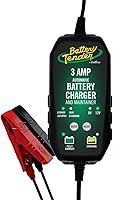
Battery Tender 3A: routine seasonal storage
The Battery Tender 3A suits owners who mainly want automatic float maintenance for a compatible lead-acid battery. It supports selectable 6V and 12V operation, including AGM and gel types.
Choose it for a stored car or other supported battery when you don't need boost charging or an engine-start function. The ring-terminal and alligator-clip combination supports either repeated access or temporary attachment.
Its status light helps you check charging progress, while float mode maintains the battery after charging. Reverse-polarity detection adds protection against an incorrect lead connection.
Skip it if your main task is quickly recharging a large, depleted battery. For lithium use, confirm the exact chemistry and mode support in the instructions for model 022-0202-COS before buying.
Schumacher SC1281 6A: broader garage work
The Schumacher SC1281 6A suits owners who need maintenance plus charging and engine-start functions. It supports standard, AGM, gel, and deep-cycle lead-acid batteries with automatic voltage detection.
Choose it when you want one garage unit for routine charging, battery and alternator checks, and occasional starting assistance. Its 100A engine-start and 12A to 30A boost functions serve different jobs from maintenance mode.
Skip it if you only need a lightweight unit for seasonal storage. At 12.7 pounds, it takes more effort to move and position than the smaller options here.
Select the mode for the task rather than choosing the highest output. Before using boost, restoration, or engine-start functions, confirm that the battery and vehicle instructions permit them.
Which common mistakes should you avoid?
Avoid using extra output or special modes to solve an unexplained charging problem. A warning or slow charge calls for checking the setup before changing settings.
- Choosing by vehicle alone: Two batteries in similar cars can have different chemistry and charging needs.
- Using boost for storage: Starting assistance and rapid charging are separate jobs from long-term maintenance.
- Repeating repair cycles: A restoration feature can't repair every cause of lost capacity or internal damage.
- Ignoring electrical draw: Accessories left on can drain a battery faster than a small maintainer replenishes it.
- Trusting automatic voltage detection alone: You still need to confirm the battery type and any required chemistry setting.
Keep terminals and connections clean according to the battery manual. A loose or corroded connection can interrupt charging and make charger behavior harder to interpret.
What signs mean you should stop charging?
Stop charging for unusual heat, swelling, leakage, an unusual smell, or a charger fault. Don't resume until you've identified and addressed the cause.
Keep flames and sparks away from a battery that may be releasing gas. Avoid disturbing its clamps, and get qualified help if you can't shut down the equipment safely.
Damaged cables, unexpectedly hot connections, or repeated warnings also need attention. Don't keep resetting the charger in the hope that a persistent fault will disappear.
A battery that charges but quickly loses power may need diagnosis or replacement. Maintaining its charge won't resolve an internal fault or an unexplained vehicle drain.
How do you choose a tender that won't harm your battery?
A battery tender can harm a battery, so choose by chemistry, voltage, condition, and charging limits first. Then match the charger to the work you need it to do.
Choose the NOCO Genius5 for compatible batteries when temperature adjustment and multiple chemistry modes are useful. Pick the Battery Tender 3A for routine float maintenance, or the Schumacher SC1281 6A for broader garage charging and starting tasks.
If the battery is damaged or keeps losing charge, resolve that problem before leaving any maintainer connected. For help matching the device to your vehicle and storage routine, see battery maintainers and chargers for cars, trucks, and boats.
Frequently asked questions
Can a battery tender overcharge a battery?
Yes, a battery tender can overcharge a battery if its charging mode is incompatible or the charger develops a fault. Automatic maintenance reduces this risk, but you still need the correct voltage and chemistry setting, sound connections, and periodic checks for unusual heat, leakage, or charger warnings.
Is it safe to leave a battery tender connected all winter?
Yes, winter-long maintenance can be suitable when both manuals allow it and the battery is healthy. Use the correct mode, keep the setup within its temperature and moisture limits, and inspect it periodically; our guide to leaving a battery tender on all the time explains storage checks.
Can a battery tender damage an AGM battery?
Yes, an incompatible charging profile can damage an AGM battery; choose a charger that explicitly supports AGM, then follow the battery maker's charging limits and mode instructions. Don't assume a repair setting or a higher-output mode is suitable just because the charger also has a normal AGM setting.
Should I disconnect a battery tender if the battery gets hot?
Yes, stop charging if the battery becomes unusually hot, swells, leaks, or gives off an unusual smell; shut off charging as the manual directs if you can do so safely. Avoid disturbing clamps near a battery that may be releasing gas, and get qualified help if approaching it is unsafe.