8 Best Marine Battery Charger (October 2026)
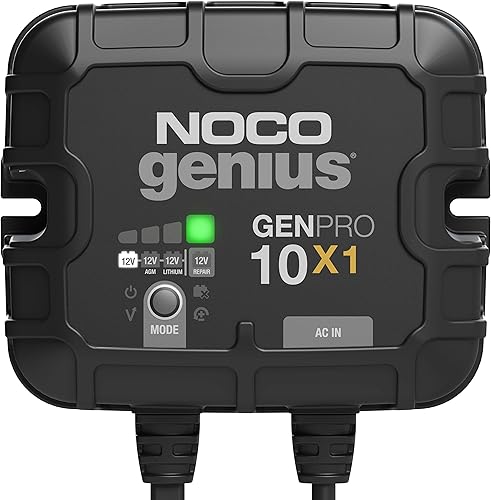
The best marine battery chargers include the NOCO GEN5X2 Marine for weekend boaters, the NOCO GENPRO10X1 Marine for single-battery boats, and the NOCO GENPRO10X2 Marine for frequent fishing trips.
On this page (11 sections)
- How we chose marine battery chargers
- The best marine battery chargers for different boats
- How do you choose the right marine charger size?
- How many charging banks does your boat need?
- Should you choose an onboard or portable charger?
- What battery chemistry and voltage should it support?
- How should you set up a marine battery charger?
- Is a marine battery charger waterproof?
- Which charging mistakes cause the most trouble?
- How do you care for batteries between trips?
- Verdict: which best marine battery charger fits your boat?
The NOCO GEN5X2 Marine is the best marine battery charger for many two-battery boats because it combines independent charging modes with a sealed onboard design. Choose a different model when your battery count, recharge window or system voltage calls for it.
Start with the batteries already in your boat, including their capacity and allowed charging current. A charger that covers every battery and finishes before your next trip is more useful than one with a bigger total amp number.
For help with output and capacity, read our guide to choosing a battery charger size. If your boat battery is AGM, our AGM battery charger picks explain chemistry-specific modes.
Our picks at a glance
-
1

-
2
-
3

How we chose marine battery chargers
We prioritized battery coverage, current per bank and installation fit. The order favors onboard marine use, while the lower-current options serve storage and smaller charging jobs.
The GEN5X2 leads for a common starter-and-deep-cycle setup. The higher-output GENPRO models make more sense when batteries lose substantial charge and need to be ready again sooner.
Shared features appear in the comparison and product cards below. The write-ups focus on the buying tradeoffs, including when you should choose another model.
| Product | Best for | Banks | Output | Protection | Our score |
|---|---|---|---|---|---|
| NOCO GEN5X2 Marine | weekend boaters | 2 | 10A total, 5A per bank | IP68 | 8.8 |
| NOCO GENPRO10X1 Marine | single-battery boats | 1 | 10A | IP68 | 8.6 |
| NOCO GENPRO10X2 Marine | frequent fishing trips | 2 | 20A total, 10A per bank | IP68 | 8.5 |
| NOCO GEN5X3 Marine | three-battery boats | 3 | 15A total, 5A per bank | IP68 | 8.1 |
| Battery Tender Plus 4-Bank | winter battery storage | 4 | 1.25A per bank | IP65 weather resistant | 7.8 |
| NOCO Genius2X2 | boat-and-powersport owners | 2 | 4A total, 2A per bank | 7.6 | |
| Battery Tender 5A 12V/24V Onboard | selectable-voltage setups | Selectable 5A or 2.5A | 7.4 | ||
| NOCO Genius2X4 | mixed-vehicle storage | 4 | 8A total, 2A per bank | 7.2 |
The best marine battery chargers for different boats
Choose the bank count first, then the charging rate each battery needs. The first four picks focus on fixed onboard charging; the remaining options cover storage, mixed vehicles or selectable system voltage.
NOCO GEN5X2 Marine: Best for weekend boaters
- Two independent 12V banks
- 10A total, 5A per bank
- IP68 waterproof rating
- Selectable battery modes
A practical onboard choice for a starter battery and a separate deep-cycle battery when you have time between trips. Independent modes let each bank match its connected battery.
Pros
- Independent charging modes for each bank
- Sealed IP68 design
- Temperature compensation
Cons
- Modest output for large, deeply discharged batteries
- 12V batteries only
The NOCO GEN5X2 Marine fits a boat with a separate starting battery and deep-cycle battery, especially when outings are spaced several days apart. Its 5A per bank makes sense for routine replenishment when you have a generous charging window.
Independent modes are useful if one battery is AGM and the other uses a different supported chemistry. Set each output for the battery it serves rather than giving both banks the same setting out of habit.
This is also a sensible choice when your starting battery sees light use but your house battery does more work. Separate outputs let each battery follow its own charging process.
Skip it when a large deep-cycle battery regularly comes back heavily depleted and must be ready early the next morning. The GENPRO10X2 gives each battery more current, provided both batteries permit that rate.
Don't buy the GEN5X2 expecting its unused output to become a dedicated higher-current bank. Select a charger around the stated output of each bank.
NOCO GENPRO10X1 Marine: Best for single-battery boats
- One 12V bank
- 10A output
- IP68 waterproof rating
- Selectable battery modes
A dedicated onboard charger for one battery that accepts its full output. It suits a simple boat setup where a second charging bank would go unused.
Pros
- Full output dedicated to one battery
- Sealed IP68 design
- Temperature compensation
Cons
- Cannot charge two batteries separately at once
- 12V batteries only
The NOCO GENPRO10X1 Marine is the direct choice for a boat with one battery to charge. Its dedicated 10A output avoids buying a second bank that your current setup won't use.
It suits a simple boat whose battery needs more than occasional storage maintenance. Check the battery's permitted current first, especially if it has a smaller capacity.
An onboard installation also removes the need to attach portable clamps before each charge. You still need to inspect the permanent connections and provide a suitable AC connection.
Skip this model if you already plan to add a separate house or trolling-motor battery. A two-bank charger can cover that future arrangement without requiring you to move connections between batteries.
Also skip it if your main task is keeping a nearly full battery ready through a long layup. A lower-current maintainer may cover that job, while the extra charging output offers little benefit during storage.
NOCO GENPRO10X2 Marine: Best for frequent fishing trips
- Two independent 12V banks
- 20A total, 10A per bank
- IP68 waterproof rating
- Selectable battery modes
Choose this two-bank model when replacing charge between frequent outings matters more than modest output. Both batteries must allow the charging current.
Pros
- More current per battery than the GEN5X2
- Separate charging modes
- Sealed IP68 design
Cons
- No third charging bank
- Extra output may be unnecessary for storage
The NOCO GENPRO10X2 Marine suits frequent trips with two batteries, particularly when a deep-cycle battery supplies substantial power between charges. It provides 10A per bank, rather than the GEN5X2's lower per-bank current.
That difference matters most during the earlier part of a recharge, when the battery can accept the available current. It won't make every charge take half as long because current falls as the battery approaches full.
Choose it when charging time is a real constraint, not simply because a larger total sounds better. Both batteries need to support its output and the selected charging mode.
Measure the proposed mounting space before ordering: the enclosure measures 10.28 x 9.25 x 6.06 in. Leave the clearance required for wiring and heat dissipation.
Skip it if you need three separate charging outputs. More current on two banks does not replace a missing third bank, and it does not automatically solve an undersized battery system.
NOCO GEN5X3 Marine: Best for three-battery boats

- Three independent 12V banks
- 15A total, 5A per bank
- IP68 waterproof rating
- Selectable battery modes
Three banks let you connect three batteries without moving a charger between them. It suits owners who value complete coverage and have a longer charging window.
Pros
- Three independently controlled banks
- Sealed IP68 design
- Temperature compensation
Cons
- Modest current per battery
- 12V batteries only
The NOCO GEN5X3 Marine suits a boat where three batteries all need attention after each outing. It avoids leaving one battery out of the charging routine or moving a smaller charger between connections.
Its three 5A banks favor complete coverage over high current to a smaller number of batteries. That tradeoff works when your boat sits long enough between uses for each battery to finish charging.
A boat with a starter battery and two trolling-motor batteries may be a candidate. If those trolling batteries are connected in series, confirm that the exact arrangement is permitted and follow NOCO's connection diagram.
Label the charger leads by battery position during installation. Clear labels make later battery replacement less confusing, especially when adjacent batteries look alike.
Skip this model if short charging windows are your main problem. Adding a third bank does not increase the current delivered to either of the other batteries, so calculate your recharge needs before choosing it.
Battery Tender Plus 4-Bank: Best for winter battery storage

- Four 12V charging stations
- 1.25A per bank
- IP65 weather resistant
- Supports lead-acid and LiFePO4
A storage-focused choice for several batteries that mostly need their charge maintained. Automatic float operation suits that role better than rapid recovery after heavy use.
Pros
- Connects four batteries at once
- Automatic float maintenance
- Clip and ring-terminal connections
Cons
- Slow replenishment of large charge deficits
- Weather resistance does not permit immersion
The Battery Tender Plus 4-Bank is a good fit for several batteries in storage, including boat batteries removed for the off-season. Its 1.25A per station favors maintaining charge and replenishing small losses.
Automatic float operation supports that storage role. The included alligator-clip and ring-terminal connections give you options for temporary access or a recurring connection.
Choose it when the batteries arrive near full and your goal is keeping them ready. Four simultaneous stations can simplify a storage routine without requiring four separate chargers.
Skip it for rapid recovery of large trolling-motor batteries after a long day. A low-current charger may need far more time than your schedule allows, even when it is compatible with the battery.
Battery Tender rates this model IP65 weather resistant, which is not an immersion rating. Put it in a location allowed by its manual and keep the surrounding power connections protected from water.
NOCO Genius2X2: Best for boat-and-powersport owners
- Two charging banks
- 4A total, 2A per bank
- Supports 6V and 12V applications
- Temperature compensation
A flexible choice for two smaller batteries or maintenance across different vehicles. Check the voltage and chemistry combination supported by each charging mode.
Pros
- Supports several vehicle types
- Clamps with integrated eyelets
- Includes two DC extension cables
Cons
- Modest charging current
- Check suitability before permanent marine installation
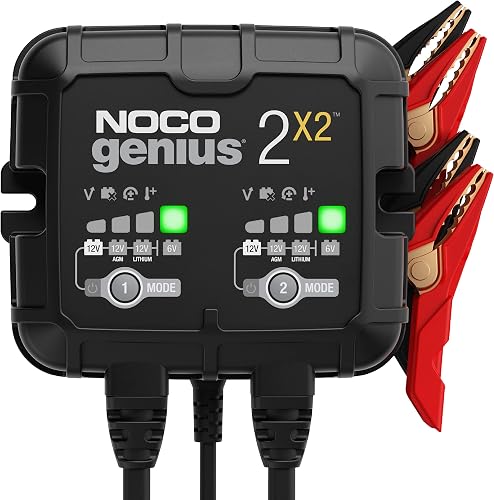
The NOCO Genius2X2 suits an owner who charges boat and powersport batteries in the same storage area. Its two outputs provide 2A each, making smaller charging jobs and maintenance its strongest roles here.
It supports 6V and 12V applications, but chemistry and voltage must be checked together. Don't assume every supported chemistry works at every selectable voltage.
The clamps have integrated eyelet terminals, and two 10 ft DC extension cables help reach separated batteries. Plan the cable route so the extra length stays clear of walkways, doors and sharp edges.
Choose it if flexibility between vehicles matters more than permanently charging a working boat. It can reduce the need to move one charger back and forth between two stored batteries.
Skip it for quick replenishment of a large marine battery. Also check its installation instructions before mounting it in a boat, rather than treating marine-battery compatibility as approval for any onboard location.
Battery Tender 5A 12V/24V Onboard: Best for selectable-voltage setups

- Selectable 12V or 24V operation
- Selectable 5A or 2.5A output
- Screw-mount installation
- Float maintenance mode
Consider this onboard model when charging a supported complete 12V or 24V system is the main requirement. Confirm chemistry compatibility and the current available in the selected mode.
Pros
- Selectable system voltage
- Integrated mounting
- Reverse-polarity detection
Cons
- Chemistry compatibility needs confirmation
- Voltage selection requires care
The Battery Tender 5A 12V/24V Onboard deserves consideration when charging a complete 24V system is the deciding need. Its selectable system voltage sets it apart from the dedicated 12V marine models above.
It also offers selectable 5A or 2.5A output and integrated screw mounting. Confirm how the current settings apply to your selected voltage before choosing it for a particular recharge window.
This approach differs from connecting separate charger banks across individual batteries. Follow the approved wiring arrangement for your complete system, especially where battery switches or other charging equipment are present.
Choose it only after confirming compatibility with your battery chemistry. A voltage match alone is not enough to select a safe charging profile.
Skip it if your goal is independent charging of different battery types. The two-bank NOCO marine models make that purpose clearer through their separate outputs and modes.
After installation, label the required voltage setting so future battery service doesn't lead to an incorrect selection.
NOCO Genius2X4: Best for mixed-vehicle storage

- Four charging banks
- 8A total, 2A per bank
- Supports 6V and 12V applications
- Temperature compensation
Four outputs suit a storage area holding boat, powersport and other vehicle batteries. Choose it for maintenance and smaller charging jobs rather than a short turnaround on large marine batteries.
Pros
- Four simultaneous charging outputs
- Clamps with integrated eyelets
- Includes four DC extension cables
Cons
- Low current for large charge deficits
- Check suitability before permanent marine installation
The NOCO Genius2X4 suits a storage area with several vehicles, where four batteries need regular attention. Its 2A per bank is better matched to maintenance and smaller charge deficits than a fast turnaround on large marine batteries.
Compared with the Genius2X2, the main gain is coverage: you can connect four batteries rather than two. Each output still has the same current available.
Four included 10 ft DC extension cables help reach batteries stored apart. Give each cable a clear route and a label so you can identify which battery belongs to each charging indicator.
Choose it when the ability to serve different supported 6V and 12V applications matters across your garage or storage space. Confirm the correct mode for every connected battery.
Skip it if all four batteries return deeply discharged and need to be ready quickly. A charger can have enough banks while still providing too little current for your schedule.
For fixed marine use, check the permitted environment and mounting conditions before installation.
How do you choose the right marine charger size?
Choose by battery capacity, charge deficit and amps per bank. Total charger output matters only after you know how that output is divided.
Begin with the battery maker's recommended charging range. More current is useful only within that range, and a smaller battery may need less current than a larger charger supplies.
Next, estimate how much charge you usually replace after an outing. A lightly used starting battery and a deeply discharged trolling battery can have very different charging needs, even if their capacities are similar.
For a step-by-step explanation of capacity and current, see our battery charger size guide. Our charger vs maintainer guide explains why storage maintenance needs much less output than routine recharging.
Which marine battery charger output fits your batteries?
Divide the amp-hours you need to replace by charging amps for a rough starting point. Then allow extra time for charging losses and the slower final stage.
For example, replacing 50Ah at 5A gives a simple estimate of 10 hours before those allowances. At 10A, the same calculation gives 5 hours, but neither result is a promised completion time.
Loads left running during charging can lengthen that window because some charger output powers the boat instead of replenishing the battery. Turn off unnecessary loads when the boat's instructions allow it.
If your normal charging window is shorter than the estimate, choose more suitable output or revisit your battery-use plan. Repeatedly leaving before a full charge can be especially hard on lead-acid batteries.
How many charging banks does your boat need?
Count the batteries you need to charge separately at the same time. A bank is a charging output, not a measure of battery capacity or total system voltage.
For a starter battery and a separate house battery, two independent outputs are often the simplest arrangement. Three separately charged batteries need three outputs if you want them all connected at once.
Series wiring raises system voltage, while parallel wiring increases capacity at the same nominal voltage. Neither arrangement should be treated as a set of loose batteries without checking the approved charging method.
Do not join charger outputs to create more current unless the charger instructions explicitly permit it. Likewise, a battery selector switch does not automatically make a single-bank charger suitable for every battery behind it.
Draw your battery layout before shopping. Include switches, series links and other charging sources so you can compare the actual wiring with the charger's instructions.
Should you choose an onboard or portable charger?
Choose onboard charging for a permanent boat installation and a portable arrangement when you regularly remove batteries or charge several vehicles. The location matters as much as the charger connection.
The four NOCO GEN5X and GENPRO models here share sealed IP68 enclosures, temperature compensation and selectable normal charging modes. They also offer Repair Mode, which requires separate care.
Those onboard models include 72 in DC leads with eyelets and a 72 in AC cable. Measure the routed distance, including bends and service slack, rather than only the straight line between charger and battery.
Portable clamps are convenient for occasional charging, while secured eyelet connections suit repeated use. Neither connector style makes a charger suitable for a wet compartment or a space near fuel.
Before choosing a mounting spot, check:
- Enclosure space plus required clearance.
- Cable reach without tension or sharp bends.
- Access to indicators and controls.
- An approved AC supply and connection.
- Ventilation and any ignition-protection requirements.
What battery chemistry and voltage should it support?
Match voltage and chemistry together for every battery you connect. AGM, flooded lead-acid, gel and LiFePO4 batteries can require different charging profiles.
Read the battery label before selecting a mode. If its identity is unclear, resolve that first rather than guessing from case size, terminal style or the boat it came from.
Independent charging modes help when batteries differ, but they do not make all battery combinations suitable for one boat circuit. Follow the boat and battery instructions for the whole electrical system.
Repair Mode is not a stronger everyday charging setting. Use it only on approved battery types and follow instructions about isolating connected electronics.
Lithium batteries may also have temperature limits enforced by their battery-management system. A charger's ambient-temperature sensor does not replace those battery-specific limits or authorize charging outside them.
How should you set up a marine battery charger?
Install the charger with AC power disconnected, following its manual and the boat's wiring requirements. For a permanent installation you cannot confidently match to an approved diagram, use a qualified marine electrician.
First inspect each battery for a damaged case, leakage, loose hardware or damaged cables. Don't charge a visibly damaged or frozen battery.
Next, secure the charger and route its cables away from fuel lines, moving parts and sharp surfaces. Avoid pulling leads tight, and support them so vibration doesn't work against the terminals.
Make the DC connections in the sequence specified by the charger and boat manuals. Our guide to hooking up a battery tender explains basic connection planning, while the marine installation instructions govern your exact setup.
Select the correct mode for each bank before normal use. Once powered, check that every connected battery has the expected charging indication and that no fault remains unresolved.
Check the first complete charging cycle before relying on the setup between trips. A charger that starts normally can still reveal a connection or battery problem later.
Is a marine battery charger waterproof?
Water protection applies to the rated enclosure and approved installation conditions. It does not make the entire charging setup waterproof.
The NOCO onboard models above carry IP68 protection, but you still need a suitable mounting location. Do not choose a spot that routinely fills with water simply because the charger has a sealed case.
Protect AC plugs, extension connections and battery terminals as their instructions require. Keep cable entries free from strain, and never assume a household connection is suitable for exposed dockside use.
Inspect the installation after rough trips, battery service or any water intrusion. Look for loosened fasteners, chafed insulation and corrosion before connecting power again.
Which charging mistakes cause the most trouble?
The biggest mistakes are choosing by total amps, selecting the wrong mode and ignoring unfinished charges. Each can undermine an otherwise suitable charger.
Avoid these habits:
- Reading total output as per-bank output. Check what each battery actually receives.
- Using Repair or Force Mode as a shortcut. Follow the special procedure and battery restrictions.
- Assuming a zero-volt battery is recoverable. Damage or internal failure may prevent safe recovery.
- Disconnecting as soon as the boat can start. Starting ability does not confirm a full charge.
- Covering the charger with stored gear. Preserve the clearance required by its manual.
- Ignoring repeated fault indicators. Check connections, settings and battery condition before trying again.
The NOCO models here offer Force Mode for manual charging initiation at very low voltage. That feature does not guarantee why a battery went flat or whether it remains serviceable.
How do you care for batteries between trips?
Recharge after use and check the whole setup periodically, even when a smart charger handles maintenance. Automatic operation reduces routine work but does not replace inspection.
Keep battery tops and terminals clean using the battery maker's method. For serviceable flooded batteries, follow its electrolyte-checking instructions; sealed batteries should not be opened for that task.
If a battery repeatedly loses charge while stored, check for boat loads left on and have its condition assessed. A larger charger will not fix a damaged battery or an unwanted electrical drain.
Before a long layup, bring batteries to the recommended charge state and confirm that ongoing maintenance is approved. Our guide to leaving a battery tender connected covers the checks that matter during extended storage.
Verdict: which best marine battery charger fits your boat?
Choose the best marine battery charger for your charging window, after matching bank count and battery requirements. Write those needs down before comparing models.
Pick the GEN5X2 for a two-battery boat with time between outings. Choose the GENPRO10X1 for a single battery, the GENPRO10X2 for shorter two-battery recharge windows, or the GEN5X3 when three separate outputs matter most.
For stored batteries, compare the Battery Tender Plus 4-Bank with the Genius2X4; the Genius2X2 covers a smaller mixed-vehicle setup. Consider the selectable-voltage Battery Tender only after confirming its fit with your complete system.
If keeping already charged batteries ready is your main job, use our battery maintainer guide to choose around storage needs.
Our top 3 picks at a glance
-
1
-
2
-
3
Frequently asked questions
How many banks should a marine battery charger have?
Choose enough banks for the batteries you need to charge separately at the same time. Two separate batteries commonly call for two banks, while three call for three.
For batteries wired in series or parallel, follow an approved connection diagram rather than assuming battery count alone determines the correct wiring.
What amp rating is best for a marine battery charger?
Choose current per bank based on battery capacity, permitted charging current and available charging time. Total output can hide how little current reaches each battery.
Estimate the charge you need to replace, then allow extra time for losses and the slower final charging stage.
Can a marine battery charger charge AGM and lithium batteries?
Yes, if it has a mode approved for the battery's exact chemistry and voltage. The NOCO marine models here support AGM and 12V LiFePO4 applications.
Do not use a lead-acid repair function on a lithium battery, and check the battery maker's charging limits before selecting a mode.
Can I use a regular battery charger on a boat?
A portable charger can charge a removed boat battery when its voltage, chemistry and current match the battery's requirements. Using it inside a boat also requires approval for that location and exposure.
Check mounting, ventilation, moisture protection and restrictions around fuel before deciding where to use it.
Is an onboard marine charger waterproof?
Some onboard chargers have waterproof enclosures, but the word onboard does not guarantee water protection. The NOCO GEN5X and GENPRO models here have IP68 protection; the Battery Tender Plus 4-Bank is IP65 weather resistant.
Neither designation makes every cable joint, plug or installation location suitable for water exposure.