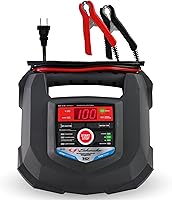
Schumacher SC1281 6A Charger Review: Worth It? (October 2026)
The Schumacher SC1281 suits drivers who want battery charging, maintenance and engine-start assistance in one garage unit. Choose the SC1280 instead if faster regular charging of a compatible 12V battery matters more than starting assistance.
On this page (9 sections)
- What does the Schumacher SC1281 offer?
- How does the SC1281 compare with the SC1280 and SC1361?
- Which charging mode should you use?
- How fast will the SC1281 charge your battery?
- How should you set up the SC1281?
- Can you leave the SC1281 connected as a maintainer?
- What can the SC1281's battery checks and restoration mode tell you?
- Which mistakes should you avoid with these chargers?
- Is the Schumacher SC1281 the right buy?
The Schumacher SC1281 is a useful garage charger if you want charging, maintenance and engine-start assistance in one unit. Its battery and alternator checks also suit drivers who want to investigate a weak-start problem before deciding what to do next.
Choose it for a mixed garage or seasonal vehicles where several battery-care jobs share one outlet. If your main task is recharging a compatible 12V battery, the SC1280's higher regular charge rate deserves more attention.
What does the Schumacher SC1281 offer?
The SC1281 combines routine battery care with boost and engine-start modes. Its value comes from handling several garage tasks, rather than having the highest regular charging current here.
Schumacher SC1281 6A: Best for mixed garages

- 6V and 12V battery support
- 2A to 6A charging
- 100A engine start
- Battery and alternator tester
Choose this garage unit when you need routine battery care, starting assistance and battery checks across several vehicles. Its broader set of functions comes with more weight than either alternative.
Pros
- Automatic voltage detection for 6V and 12V batteries
- Separate boost and engine-start modes
- Battery and alternator checks
- Smart trickle charge and desulfation mode
Cons
- Regular charging tops out at 6A
- Heaviest of these 3 chargers
It supports standard, AGM, gel and deep-cycle batteries across cars, trucks, SUVs, motorcycles, ATVs and marine uses. Match the actual battery to the charger instructions, since a vehicle category alone doesn't confirm compatibility.
The unit uses battery clamps and requires a 120V outlet. Think of it as equipment for a powered garage or workshop, rather than a cordless jump pack you can use anywhere.
Its automatic voltage detection helps with compatible batteries of different voltages. You still need to identify the battery type and confirm the allowed charge settings before connecting it.
Who should buy the Schumacher SC1281?
Buy the SC1281 if your work includes stored vehicles, occasional weak starts and battery checks. It makes particular sense when you have a regular place to keep it near the vehicles you maintain.
A household with a daily driver and seasonal equipment can use its different modes as needs change. The reason to choose it is that mix of jobs, not the assumption that every battery needs boost charging.
Skip it if you only want a small device for keeping one healthy battery charged during storage. Also look elsewhere if you need starting help where no suitable power outlet is available.
For broader care options, see battery maintainers and chargers for cars, trucks and boats. If you're new to connecting a charger, start with how to charge a car battery.
How does the SC1281 compare with the SC1280 and SC1361?
Choose the SC1281 for several garage jobs, the SC1280 for regular recharging, or the SC1361 for a household with compatible 12V batteries. The largest current number on the box isn't a useful comparison until you know which mode it describes.
| Feature | Schumacher SC1281 6A | Schumacher SC1280 15A | Schumacher SC1361 6A |
|---|---|---|---|
| Regular charging | 2A to 6A | 15A for 12V; 2A for 6V | 2A to 6A |
| Battery voltage | 6V and 12V | 6V and 12V | 12V |
| Engine-start output | 100A | Choose for charging and maintenance | 50A |
| Boost charge | 12A to 30A | Choose for regular charging | 10A |
| Battery checks | Battery and alternator | Battery | Choose for charging and starting |
| Weight | 12.7 lb | 2.7 lb | 9.5 lb |
Schumacher SC1280 15A: Best for frequent recharging

- 15A charging for 12V batteries
- 6V and 12V battery support
- Battery checks and restoration
- Smart trickle charging
A lighter choice for drivers who regularly recharge compatible 12V batteries and don't need an engine-start mode. Its separate 6V mode also covers older equipment with suitable batteries.
Pros
- Higher regular 12V charge rate than the other picks
- Supports both battery voltages
- Charges, maintains, checks and restores batteries
Cons
- 6V charging is limited to 2A
- Choose another model for engine-start assistance
The SC1280 suits someone who regularly plugs in a discharged car battery and can leave it to charge. Its lower weight also makes it easier to carry between a shelf, vehicle and workbench.
Its higher regular charge rate is useful only when the battery permits that current. A small powersport battery may need a lower rate, so don't choose this model solely because its maximum output is higher.
Skip the SC1280 if engine-start assistance is a firm requirement. Its strength is charging and maintaining batteries, with battery checks and a desulfation function alongside those tasks.
Schumacher SC1361 6A: Best for 12V households

- 12V battery support
- 2A to 6A charging
- 50A engine start
- Reverse hook-up protection
A focused choice for households with compatible 12V batteries that want charging, maintenance and starting assistance. Skip it if your equipment needs 6V charging.
Pros
- Reverse hook-up protection
- Smart trickle charge
- Engine-start mode
- Lighter than the SC1281
Cons
- Supports 12V batteries only
- Lower engine-start output than the SC1281
The SC1361 suits drivers whose compatible batteries all use the same voltage and who want charging plus starting assistance. Reverse hook-up protection prevents operation when the clamps are reversed, but careful connection still matters.
Choose it when you don't need the SC1281's broader battery support or diagnostic functions. Skip it if you maintain 6V equipment, and don't assume its starting mode will suit every engine just because the vehicle uses a compatible battery.
Which charging mode should you use?
Use regular charging for replenishing a battery, maintenance for keeping a charged battery ready, and engine-start mode only for the starting procedure in the manual. Boost is a separate function with its own instructions and limits.
The SC1281's regular charge range tops out at 6A. Its much larger boost and starting figures don't mean it continuously charges a battery at those outputs.
Before choosing a mode, read the battery label for voltage, chemistry and any charging limits. Check the vehicle manual too, especially if it specifies charging terminals or steps for protecting vehicle electronics.
A charger can support AGM batteries without making every setting suitable for every AGM battery. The same care applies to small motorcycle batteries and batteries used in boats or equipment.
For a clearer distinction between replenishing charge and holding it during storage, read battery maintainer vs battery charger. That distinction can save you from buying more equipment than your usual task requires.
How fast will the SC1281 charge your battery?
Charge time depends on battery capacity, how much charge is missing and battery condition. Allow time for the final charging stage rather than expecting the maximum current to continue until the battery is full.
As a rough planning example, replacing 30 amp-hours at a steady 6A would take 5 hours before charging losses and the slower finish. Actual charging can take longer, and the charger may reduce current as the battery fills.
A larger battery doesn't automatically require the highest available current. Follow its allowed charge rate, then decide whether the SC1281 gives you a practical wait time for your routine.
If you often need a substantial recharge between short periods of use, the SC1280 may fit better. For occasional overnight charging and several other garage jobs, the SC1281's wider role may matter more.
See how long it takes to charge a car battery for the factors behind the wait. Our guide to what size battery charger you need helps connect battery capacity with charger choice.
How should you set up the SC1281?
Set up the SC1281 with the power disconnected, the battery identified and the manual within reach. Use a dry, stable location with ventilation, and keep the charger clear of the battery rather than resting it on top.
Inspect the battery case, terminals, clamps and leads before starting. Don't charge a frozen, leaking, swollen or visibly damaged battery.
Keep flames, sparks and smoking away from the charging area, since lead-acid batteries can release flammable gas. Wear eye protection and remove metal jewelry before working near exposed terminals.
Use this preparation order:
- Confirm the battery's voltage, chemistry and permitted charging current.
- Check the vehicle manual for designated charging points and any required preparation.
- Route the leads away from belts, fans, sharp edges and hot parts.
- With AC power disconnected, attach the clamps in the sequence and locations required by the charger and vehicle manuals.
- Connect power, select the proper function and check that operation begins normally.
For an installed battery, the required negative connection may be a designated chassis point away from the battery. Don't assume the same clamp placement applies to every vehicle or to a battery removed from a vehicle.
After charging, disconnect AC power before removing the clamps in the required sequence. Never close a hood onto the leads or pull the unit by its cables.
Can you leave the SC1281 connected as a maintainer?
Yes, its smart trickle charge supports ongoing battery maintenance when used as directed. Extended connection still requires a suitable location, sound connections and periodic checks.
Begin storage with a battery that can accept and hold a charge. Maintenance is meant to replace charge lost over time, rather than make a failing battery dependable.
Check that the leads remain secure and that nothing has damaged or pinched them. Look for unexpected charger indications, battery damage or unusual heat, and stop use if something appears wrong.
Don't leave the charger exposed to weather simply because the battery belongs to a boat or outdoor vehicle. Choose a location permitted by the manual and keep the power connection dry.
For longer storage periods, leaving a battery tender connected covers the practical checks worth building into your routine.
What can the SC1281's battery checks and restoration mode tell you?
The SC1281's battery and alternator checks can help narrow down a starting problem. Its desulfation mode offers a recovery option for suitable batteries, but it can't repair physical damage or guarantee recovery.
A battery that repeatedly loses charge needs more attention than another restoration attempt. Loose connections, a vehicle electrical drain, charging-system trouble or an aged battery can all cause recurring problems.
Use the charger's indications according to its manual, then seek a qualified diagnosis if the cause remains unclear. A single reading shouldn't decide a battery replacement without considering charge state and the vehicle's symptoms.
Don't use desulfation as a routine setting for every battery. Confirm that the exact battery and connection setup permit the mode before using it.
Which mistakes should you avoid with these chargers?
Avoid choosing by peak output alone or using a high-current mode to rush a routine charge. Correct battery matching and mode selection matter more than the biggest number.
- Confusing starting with charging: a successful start doesn't mean the battery is fully charged or healthy.
- Ignoring small-battery limits: a motorcycle or ATV battery may require less current than a car battery.
- Trusting automatic detection without checking: confirm voltage and chemistry yourself before connecting.
- Repeating failed start attempts: follow the manual's cranking and cooling limits instead of trying continuously.
- Treating reverse-polarity protection as permission to guess: identify terminals and connection points before attaching clamps.
- Putting the charger away damp or dirty: disconnect it, let it cool and follow its cleaning instructions before storage.
Store the leads without tight bends or strain at the clamps. Inspect insulation before each use, particularly if the charger shares space with tools or gets moved between vehicles.
Is the Schumacher SC1281 the right buy?
Choose the Schumacher SC1281 when charging, battery checks and starting assistance all belong in your garage routine. Its weight is easier to accept when it can stay near your work area and serve several vehicles.
Pick the SC1280 when routine recharging is the main job and your battery permits its higher regular current. Choose the SC1361 when your batteries are compatible 12V types and you want charging, maintenance and starting assistance without needing the SC1281's wider functions.
Before ordering, check your battery label, allowed charge rate and access to a suitable outlet. For another approach to routine battery care, read our NOCO Genius10 review.
Frequently asked questions
What does the Schumacher SC1281 do?
The SC1281 combines battery charging, maintenance, battery and alternator checks, desulfation and engine-start assistance; its regular charge, boost and starting modes serve different jobs. Choose the mode that matches your battery and task, and follow the manual's limits rather than treating the highest output as an everyday charging setting.
Can the Schumacher SC1281 charge AGM batteries?
Yes, the SC1281 supports compatible AGM batteries, along with standard, gel and deep-cycle batteries; confirm the voltage and permitted charging current on your battery before connecting it. Automatic voltage detection doesn't replace checking battery chemistry, selecting the proper settings or following the battery manufacturer's charging instructions.
Is the SC1281 a battery maintainer?
Yes, the SC1281 includes smart trickle charging to maintain battery voltage over time; use it with a compatible battery and follow the manual's rules for placement, connection and periodic checks. For storage and routine care advice, see our guide to battery maintainers for cars.
What is the difference between the SC1281 and SC1280?
The SC1281 adds boost and engine-start assistance, while the SC1280 offers a higher regular charging rate for compatible 12V batteries; both support 6V and 12V batteries and ongoing maintenance. Choose the SC1281 for its wider garage role or the lighter SC1280 when routine recharging is your main task.